Fish population data on this page comes from the Minnesota DNR Standard Survey of Lake Minnetonka (most recent on file: June 2022) and the 2019 DNR nearshore (IBI) survey. As of this writing, June 2022 is the most recent Standard Survey published for this lake. Bay-to-basin groupings are the DNR's own published assignments from West Metro Fisheries basin-level reporting.
Jump to a section:
- 🗺️ Minnetonka Isn't One Lake
- 📅 Which Basin, and When
- 🎣 Largemouth Bass: The Lake's Real Reputation
- 🐟 Northern Pike: The Healthy, Naturally Reproducing Fishery
- 🎯 Walleye: Stocked, Not Natural
- 🏷️ Muskie: The Tag Study Worth Knowing About
- 🐠 Bluegill, Crappie, and the Rest
- ❄️ Minnetonka Under the Ice
- 🚤 Access, Crowds, and the After-Work Window
- 📋 Regulations Summary
- 📊 Minnetonka at a Glance
- ❓ FAQ
🗺️ Minnetonka Isn't One Lake
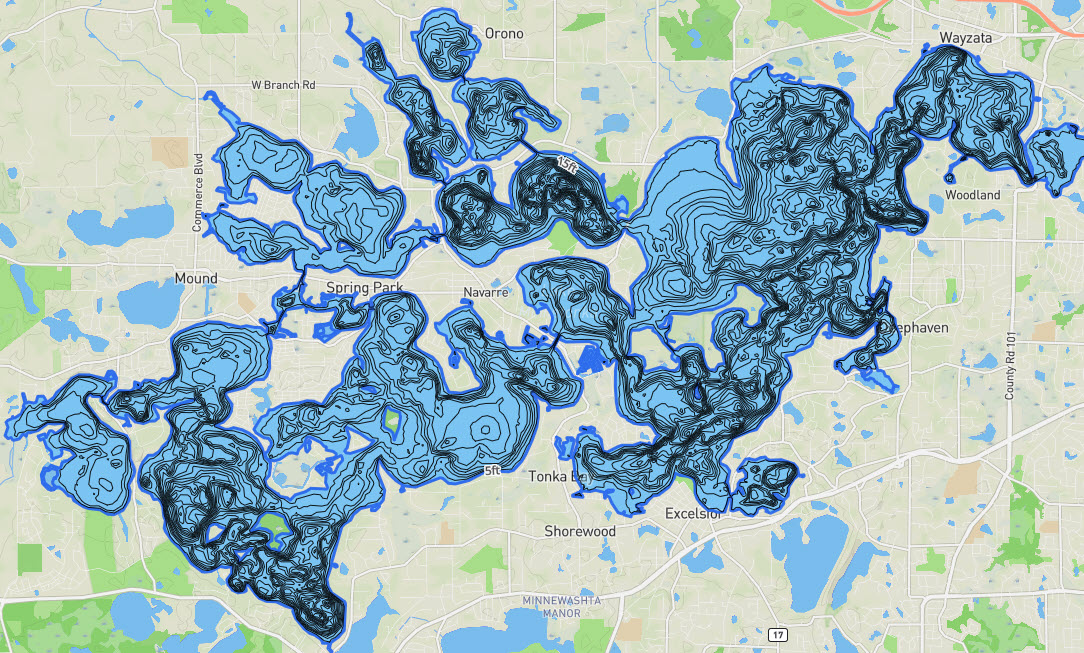
Ask "where's the best spot on Lake Minnetonka" and you'll get a shrug, because the question doesn't really make sense. At 14,200-plus acres, Minnetonka is a system of more than 30 connected bays, and several of them — Halsted's, Cook's, Wayzata, Gray's — run 200 to 400 acres on their own. Each one has its own water quality, its own weed growth, its own personality. Treat any one of them like its own lake and the whole thing gets a lot less intimidating.
The three DNR basins, and which bays are actually in each one. The DNR groups Minnetonka's bays into three sampling basins, and the grouping is published, not a rough guess:
- North & West Bays (most fertile, first to receive runoff, warms fastest): Halsted's, Priest's, Cook's, Black Lake, Emerald Lake, Seton Lake, Harrison's, Jenning's, West Arm, Crystal, North Arm, Stubb's, Maxwell, and Forest Lake.
- Upper Lake (intermediate fertility): West Upper Lake, South Upper Lake, East Upper Lake, Smithtown Bay, Phelp's Bay, Carman's/Old Channel Bay, and Spring Park Bay.
- Lower Lake (clearest, least fertile, best water quality): Lafayette, Smith's, Brown's, Wayzata, Gray's, Robinson's, St. Louis, Carsons, St. Alban's, Excelsior, Gideon's, South Lower Lake & Echo Bay, and North Lower Lake.
That's also the fertility gradient in practice — North & West is the most fertile and warms first, the Lower Lake is the clearest and least fertile, and the Upper Lake sits in between. It's where the size differences in this guide come from, so it's worth knowing which basin your bay actually belongs to before you decide what to expect. A few that surprise people: Wayzata Bay and Gray's Bay are both Lower Lake, not the "east end" quirk they might seem like from the map; Maxwell and North Arm, up in the northwest arms, are North & West Bays even though they're not technically west of center.
| Basin | Example bays | Fertility / clarity | Walleye avg. length | Pike avg. length | Notable |
|---|---|---|---|---|---|
| North & West Bays | Halsted's, Cook's, Maxwell, North Arm, West Arm, Crystal | Most fertile, warms fastest | 16.6" | 24.7" (largest average) | Smaller walleye, but the biggest average pike |
| Upper Lake | Smithtown, Phelp's, Spring Park, the three Upper Lake sections | Intermediate | 19.1" | 22.6" | The middle ground on most metrics |
| Lower Lake | Wayzata, Gray's, Excelsior, Carsons, St. Alban's | Clearest, least fertile | 20.5" (largest average) | 21.2" | Most pike overall; only basin holding smallmouth in 2022 gill nets |
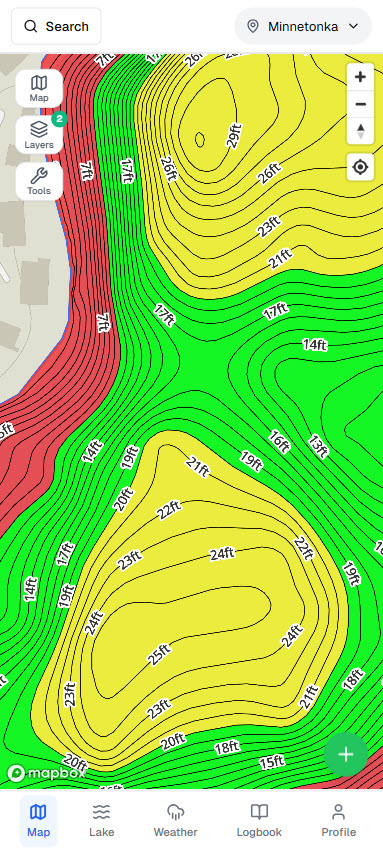
That's the pattern that repeats across the whole lake: two bays can share a channel and still fish completely differently, because each one has its own bowl.
Before you launch, pull up the contour map in Fish Guide Pro for whichever bay you're actually fishing — the depth shading will show you where that basin's break really sits.
📅 Which Basin, and When
The fertility gradient isn't just a size story — it's roughly a calendar too. The North & West Bays warm first in spring simply because they're shallower and first in line for runoff, which tends to put them ahead early in the season. The clearer Lower Lake comes on later and holds deeper structure into summer, with the Upper Lake in between. It's a rough progression, not a fixed schedule, and it moves around with the weather each year — so check the water temperature for your specific bay before you commit to a plan built on "it's early May, so..."
🎣 Largemouth Bass: The Lake's Real Reputation
Minnetonka's bass fishing carries the lake's name well beyond Minnesota, and the tournament numbers back it up better than any old survey could.
In 2022, eight permitted bass tournaments reported their results to the DNR: 792 anglers weighed in 1,681 largemouth bass, averaging 2.58 pounds, with the top fish going 8.00 pounds and 23 inches. Minnetonka also hosts some of the state's bigger tournament paydays — competitive teams have taken home five-figure prizes here on five-bass bags averaging over 4 pounds per fish.
Here's the part worth being straight about: the last time the DNR actually electrofished the lake specifically for bass was 2016, and that survey told a very different story — 138 largemouth sampled, averaging just 9.9 inches and 0.66 pounds, with the largest at 18.7 inches. That's not a population crash. Tournament anglers are actively targeting the biggest fish in the lake, and some events set their own size minimums, so tournament weigh-ins skew large by design. The electrofishing survey samples everything, including a lot of small fish that never see a tournament livewell. Both numbers are true; they're just measuring different things.
Current pattern: Summer bass tend to sit on deep weed lines — work a Ned rig heavy enough to snap through weed clumps rather than reel over them. As spring bays warm, especially in the North & West Bays, fish move shallow onto docks and sparse, skinny weed growth. Where exactly "deep" means on a given day depends heavily on which basin you're in — the Lower Lake holds weed edges much deeper than the shallower North & West Bays.
Season note: Minnesota's 2026 regulations opened largemouth and smallmouth bass to a continuous season statewide. On Minnetonka's zone (Southern/North-Central), catch-and-release ran March 1–May 22, with harvest opening May 23, 2026 and running through Feb. 28, 2027, at 6 fish combined total.
🐟 Northern Pike: The Healthy, Naturally Reproducing Fishery
Unlike the lake's stocked walleye and muskie, Minnetonka's northern pike reproduce naturally, and the population has historically run strong — that held true again in the 2022 survey.
The pattern splits by basin: the Lower Lake holds the most pike overall, while the North & West Bays hold fewer fish but the biggest ones, averaging 24.7 inches against 21.2 inches in the Lower Lake and 22.6 inches in the Upper Lake. Worth flagging honestly, though — the single largest pike in the 2022 survey, at 35.4 inches, came out of the Lower Lake, so "the North & West Bays for a big one" isn't a guarantee. Most pike caught on Minnetonka and lakes like it in the metro run in the 2–5 pound range; a 35-incher is genuinely a notable fish here.
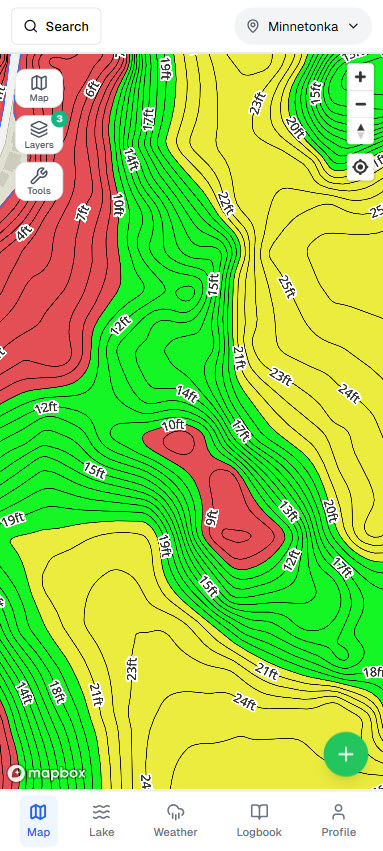
A hump pair like that — shallow, isolated, with deeper water tight on both sides — is exactly the kind of ambush structure pike relate to all season, in any basin.
Regulation: Lake Minnetonka falls in Minnesota's North-Central Zone for pike. The possession limit is 10 fish, with no more than 2 over 26 inches, and all pike between 22 and 26 inches must be released. It's a rule anglers commonly get wrong, so it's worth knowing cold before you keep anything.
🎯 Walleye: Stocked, Not Natural — Low Numbers, Big Fish
If you're coming to Minnetonka expecting a walleye factory, reset that expectation now: the population here is entirely artificial. There's no natural reproduction to speak of — every walleye in this lake traces back to a DNR stocking truck, on an alternating cycle with muskellunge, walleye in even-numbered years and muskie in odd.
Despite the long stocking history, walleye abundance has stayed low. The 2022 gill net catch rate was 2.5 fish per net, up from 1.7 in 2019, and that increase held across all three basins — from 1.2 to 2.8 fish/net in the Lower Lake, 1.8 to 2.0 in the Upper Lake, and 2.3 to 2.7 in the North & West Bays.
The upside of low numbers: the fish that are there tend to be large. Sampled walleye averaged 19.1 inches and 2.6 pounds, ranging from 10.9 to 26.4 inches, and grew to 16.2 inches by age three. Size varies by basin — smallest in the North & West Bays (16.6"), largest in the Lower Lake (20.5"), with the Upper Lake in between (19.1").
Here's the part most walleye guides won't tell you: a lot of the summer catch on this lake comes by accident, to anglers working Ned rigs and drop shots for bass in the middle of the day, not to anyone running a dedicated night program. If you want walleye specifically, lean into that — work sparser weed edges and inside turns with moving baits, rather than setting up to dead-stick a lake that just doesn't have the numbers to reward it.
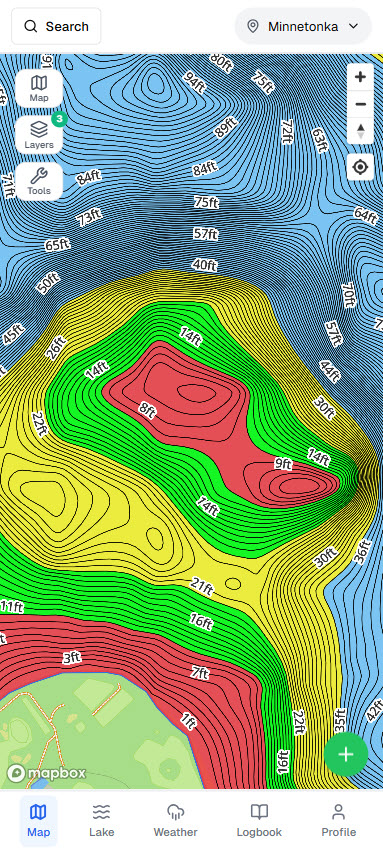
This is the kind of water the Lower Lake basin has more of than anywhere else on the lake — which tracks with it holding the biggest average walleye of the three basins.
If numbers matter more to you than size, our 10 Best Walleye Lakes in Minnesota rundown covers lakes with real natural reproduction and higher catch rates. If you're set on Minnetonka specifically, pull up the contour map in Fish Guide Pro before you launch — on a lake this size, knowing which basin you're fishing changes what you should expect to catch.
🏷️ Muskie: The Tag Study Worth Knowing About
Minnetonka's muskie fishery has been built entirely through stocking dating back to the late 1970s, alongside the even/odd-year alternation with walleye. The 2022 survey wasn't targeting muskie, but two fish turned up incidentally in the gill nets — 35.9 and 50.2 inches.
The genuinely interesting detail here: there's an active DNR tag-return study on Minnetonka, with muskie tagged in 2008, 2009, 2011, and 2012 carrying a yellow external tag near the dorsal fin on the fish's left side, marked with a six-digit number. If you catch a tagged muskie, record the tag number and the fish's length and report it through the DNR's Tagged Fish Reporting page — and don't remove the tag. Tiger muskie are also present in the lake in smaller numbers.
🐠 Bluegill, Crappie, and the Rest
Bluegill and black crappie are the dependable, close-to-shore fishery on Minnetonka, and the survey numbers back that up — bluegill abundance in particular was very high compared to similar Minnesota lakes. Trap-netted bluegill averaged 6.2 inches with the largest at 8.9 inches; black crappie averaged 8.3 inches with a 12.0-inch top end. Look to docks in 5 to 8 feet of water with sporadic rather than matted weed growth, along with main-lake points, inside turns, and humps.
Yellow perch matter here more as forage than as a target fishery — abundance was low compared to similar lakes in 2022, though size structure has been improving. Lake-wide, 14% of sampled perch exceeded 8 inches, but that number wasn't even across the lake: 25% in the Upper Lake, 21% in the North & West Bays, and none in the Lower Lake. If you're chasing bigger pike and walleye on the Lower Lake, understand the forage base there skews smaller than elsewhere on the lake.
Smallmouth bass are primarily a Lower Lake fish. The 2022 gill nets sampled smallmouth only in the Lower Lake — four fish, 10.1 to 18.3 inches, averaging 13.7 inches — but the DNR's 2019 nearshore survey also found smallmouth in the Upper Lake, so they're not strictly confined to one basin.
Rock bass and hybrid sunfish are both common in the survey data too, and they're a solid, easy answer for a kid's first fish off a dock.
❄️ Minnetonka Under the Ice
The same basin logic holds once the ice comes — the break you found in August is the break you're drilling in January, and the same basin-by-basin read on weed depth still applies. For ice-specific gear and tactics, see our Minnesota Ice Fishing Guide.
🚤 Access, Crowds, and the After-Work Window
Minnetonka is heavily developed and heavily boated. There are around a dozen public accesses around the lake, but the DNR itself notes that popular ramps get overcrowded at peak recreation times. Roughly by basin:
- Lower Lake: Gray's Bay Public Access & Marina (Wayzata) — the busiest launch on the lake, three lanes, over 100 trailer spaces; Carsons Bay (Deephaven); a smaller access off Eastman Lane in Wayzata.
- Upper Lake: Spring Park; Lake Minnetonka Regional Park (West Upper Lake, fee lot).
- North & West Bays: Maxwell Bay and North Arm (Mound/Orono) — Maxwell was added specifically to relieve congestion at North Arm; Halsted Drive (Halsted Bay); Surfside Park (Cook's Bay).
The genuinely useful tip here is timing, and sunrise is the reliable half of it: current fishing reports consistently describe the lake as quiet through 8 or 9am on summer weekends, with boat traffic picking up hard by 10–11am and staying heavy into the afternoon. Evening is less of a sure thing than people assume — accesses can still be jammed as late as 6pm on a summer Saturday, so "after dinner" only works if you mean genuinely late, closer to dusk, not right after the meal. One more lake-specific wrinkle — Minnetonka allows bowfishing for rough fish under rules coordinated through the Lake Minnetonka Conservation District, which is worth knowing if you're on the water at odd hours and see it happening.
For the metro angler, that's really the whole pitch: a few hours on Minnetonka is enough time to catch fish, if you already know which bay and which weed edge you're running — and time it around the crowds rather than against them.
📋 Regulations Summary
Lake Minnetonka has no lake-specific special regulations on file — statewide Minnesota DNR rules apply across the board (2026 Minnesota Fishing Regulations).
- Northern pike (North-Central Zone): 10-fish possession limit, no more than 2 over 26", 22–26" protected slot — release everything in that range.
- Largemouth & smallmouth bass: Continuous season as of the 2026 rule change. Catch-and-release only March 1–May 22; harvest open May 23, 2026 through Feb. 28, 2027, 6 fish combined total.
- Walleye (inland waters): 6 fish combined with sauger, only 1 over 20" in possession.
- Muskellunge (North-Central Zone): 1 fish, 54" minimum size, season runs June into late November. Tiger muskellunge: June 6–Nov. 30 season, 1 fish, 40" minimum.
- Crappie: 10 fish, combined black and white, no closed season.
- Sunfish (bluegill, pumpkinseed, and hybrids): 20 fish combined, no closed season.
Fish consumption: The Minnesota Department of Health publishes water-specific and species-specific consumption guidance based on mercury, PCB, and PFAS levels — recommended servings vary by species and can differ significantly by lake. Check Minnetonka's specific guidance at mndnr.gov/lakefinder before deciding what to keep, especially for anyone who is pregnant, breastfeeding, or feeding children under 15.
Regulations change year to year — always confirm current numbers before you fish.
📊 Minnetonka at a Glance
- Size: ~14,200 acres
- Depth: 113 ft max, 30 ft mean.
- Water clarity: 8.5 ft (Secchi)
- Trophy score: 93.1 — very high
- Invasive species present: zebra mussel, Eurasian watermilfoil, curly-leaf pondweed, flowering rush — all found in high abundance. With Minnetonka's heavy boat traffic, it's a real transport risk to other lakes; clean, drain, and dry before you launch anywhere else.
❓ FAQ
What fish are in Lake Minnetonka? Largemouth and smallmouth bass, northern pike, walleye, muskellunge, bluegill, black crappie, yellow perch, and a wide range of forage and rough fish species. Walleye and muskie are stocked; pike and bass reproduce naturally.
Is the walleye fishing good on Lake Minnetonka? Numbers are low compared to lakes with natural reproduction, but the fish that are there run large — averaging over 19 inches lake-wide, with the biggest fish typically coming from the Lower Lake.
Where's the best bass fishing on Minnetonka? The whole lake supports quality largemouth fishing, which is why it draws multiple tournaments a year. Pattern depends heavily on which bay and basin you're in — deep weed edges hold fish in summer, sparse shallow weed and docks in spring.
What are the pike regulations on Lake Minnetonka? North-Central Zone rules apply: 10-fish possession limit, no more than 2 over 26 inches, and a 22–26 inch protected slot that must be released.
Which bay should I fish on Lake Minnetonka? There's no single answer — each major bay fishes like its own lake. Start by identifying which basin your bay is in — North & West Bays, Upper Lake, or Lower Lake — then use the contour map in Fish Guide Pro to find the break in that specific bay.
Every good day on Minnetonka starts with knowing which bay you're actually fishing. Try Fish Guide Pro free and pull up the basin-by-basin contours before you launch.