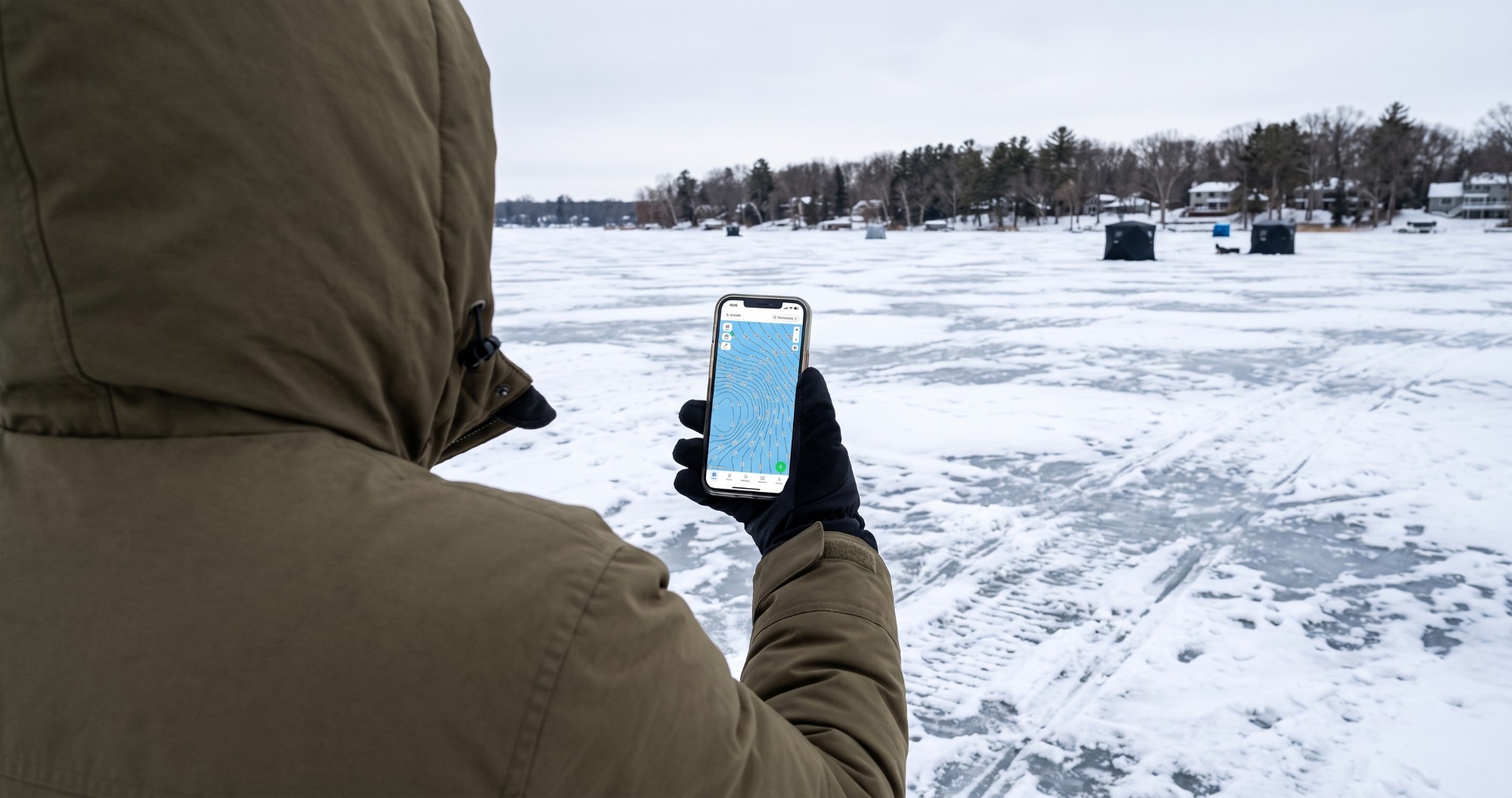
Open water closes. Minnesota doesn't stop fishing — it just changes clothes.
If you've spent any time chasing walleye off a summer breakline or working a weed edge for crappie, you already know more about ice fishing than you think. The fish don't disappear when the lake freezes over. They move, sure — but they move to something, and that something is usually structure you'd recognize from open water. This guide covers how to pick a lake and a starting spot at each stage of the ice season, which Minnesota lakes are genuinely worth the drive, a real safety framework, and where your summer structure knowledge carries over — and where it doesn't. Consider it the hub for ice season — for deeper technique and lure detail once you know where to set up, see our Walleye Seasonal Patterns guide and Reading Depth Contour Maps for help spotting structure before you drill.
The upside of figuring this out ahead of time isn't just more fish in the bucket. It's less of the day spent standing over a hole wondering if you're even in the right spot, and more of it spent actually paying attention to whoever's out there with you.
One thing this guide isn't: a live ice fishing report. Ice conditions change too fast for any static page to responsibly promise "here's the current ice" — for that, always check a local bait shop, resort, or current ice-out/ice-in report for the specific lake you're headed to. What this guide gives you instead is the stuff that doesn't change year to year: where fish sit relative to structure, which lakes are worth the drive, and how to think about safety.
Jump to a section:
- 🗓️ When to Go, Region by Region
- 🎣 Best Lakes for Minnesota Ice Fishing
- 📍 What Makes a Lake a Good Ice Lake
- 🧰 What You Actually Need
- ❄️ How Location Changes Through the Season — Early Ice · Mid-Winter · Late Ice · Panfish
- 🔄 Open-Water Knowledge: What Carries Over
- 🥶 Minnesota Ice Safety: The Framework
- 🛠️ Fish Guide Pro Tools for Ice Season
- ❓ FAQ
🗓️ When to Go: Minnesota's Ice Season, Region by Region
Minnesota is a big state, and "when does ice fishing season start" doesn't have one answer. As a rough guide:
- Far north (Lake of the Woods, Rainy Lake, Voyageurs country): First safe ice on protected bays typically forms by late November to early December, with big-lake main basins following a couple weeks behind.
- North-central and Brainerd Lakes area: Early-to-mid December in a normal year.
- Central and Twin Cities metro: Mid-to-late December, sometimes pushed into January in a mild or drought-affected winter.
- Southern Minnesota: Late December into January, and often the first area to see ice out — the point where a lake is no longer safely frozen — again come spring.
These are general patterns, not a promise for any given year — a warm stretch or a light-snow winter can shift things by weeks in either direction, so always confirm current conditions locally before heading out, especially at the edges of the season.
Shelter removal deadlines are a hard, regulated date worth building your late-season plans around: shelters must be off inland waters in the southern two-thirds of the state by March 2, the northern third by March 16, and Minnesota-Canada border waters (including Lake of the Woods) by March 31. These dates shift slightly year to year, so confirm the current-season dates before you haul a house out — but they're a useful anchor for when the season is winding down in your part of the state.
🎣 Best Lakes for Minnesota Ice Fishing
"Best" depends on what you're after, but these four hold up across the season and represent different parts of the state:
Mille Lacs (Mille Lacs County, near Garrison) — If you fish walleye in the winter, you already know this lake. 128,345 acres of mud flats, rock reefs, and long tapering breaks that give fish somewhere to actually relate to instead of a big empty bowl. It's shallower than its reputation suggests — 40 feet at the deepest, 28 feet on average — which means structure does the work here, not depth. The current walleye regulation runs three fish, all over 17 inches, only one of which may be over 20 inches. Northern pike over 30 inches must go back, and burbot are catch-and-release. Perch, tullibee, and smallmouth round it out. Confirm the current regulations before you drill — Mille Lacs rules change season to season more than almost any lake in the state.
Lake of the Woods (Lake of the Woods County, near Baudette and Long Point) — The one that runs on a different scale than everything else: 725,000 acres on the Minnesota side alone, with a winter economy built around it. Plowed ice roads run for miles off the south shore, and resorts rent heated sleeper houses parked over structure — which is how most people fish it, and the reason it's the one lake where you can show up with no gear and still fish well. Walleye and sauger are the headline, with jumbo perch, pike, tullibee, burbot, and lake sturgeon in the mix. Walleye and sauger run a combined possession limit of six with no more than four walleye, fish from 19½ to 28 inches released, and one over 28 allowed; Four-Mile Bay and the Rainy River run separate rules from the main lake, so know which water you're on. Pike from 30 to 40 inches must be released.
Upper Red Lake (Beltrami County, near Waskish) — 119,000 acres of shallow, wind-built basin that fishes almost nothing like the deep-structure lakes on this list. There's very little to relate to down there, so location is about finding the subtle hard-bottom changes and the depth band fish are using that day rather than hunting a breakline. When it's on, it's as good a walleye bite as the state offers. Upper Red is one of the few lakes with a walleye limit that changes specifically for the ice season — the winter limit drops to four fish with only one over 17 inches, separate from the open-water rule. Pike from 30 to 40 inches must be released.
One thing to get right before you go to Red: the portions of Red Lake inside the Red Lake Indian Reservation are closed to non-band members. The actual boundary isn't a clean north-south line — DNR guidance for state anglers is to stay east of longitude 94° 43' 12.0" to be certain you're on state water.
Lake Winnibigoshish (Cass County, near Bena) — "Big Winnie" gets called a deep lake because it touches 76 feet, but that's one hole in a 56,000-acre basin that averages about 15 feet. Fish it like the big shallow flat it mostly is: long tapering breaks, sand-to-rock transitions, and the handful of spots where the bottom actually drops. Walleye and jumbo perch are the draw, with a heavy tullibee forage base keeping predators fed through the cold. Walleye from 18 to 23 inches must be released, with one over 23 allowed — the regulation covers connected waters too, so know where you're standing.
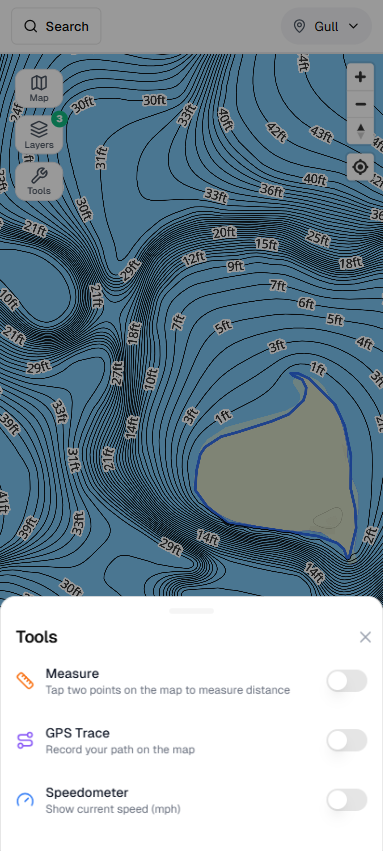
Gull Lake (Cass County, near Nisswa) — Easy to get to, and structure-rich enough that it doesn't feel like it: sharp breaks, defined points, and close to 80 feet of max depth packed into a lake you can actually learn in a season. Walleye and panfish both, plus a real pike fishery for anyone who wants a shot at something bigger while they wait on the panfish bite. Pike from 30 to 40 inches must be released, possession limit two, only one over 40 — and that applies across the connected chain, not just Gull proper.
Lake Minnetonka (Hennepin County, near Mound) — The one you fish if you're not driving north. Pressured, sure, but deep enough — over 100 feet at its max — to hold fish all winter anyway. Walleye, crappie (including white crappie, which not every lake has), and enough panfish to keep a slow day interesting. For the full basin-by-basin breakdown of where to fish it, see our Lake Minnetonka Fishing Guide.
What these lakes share isn't depth — Mille Lacs tops out around 40 feet and Winnie averages about 15. It's structure and size: enough shape on the bottom to hold fish in predictable places, and enough water to keep oxygen from becoming a problem in February. Mille Lacs and Winnibigoshish also show up in our 10 Best Walleye Lakes in Minnesota rundown, with full DNR catch-rate and slot-limit detail for open-water season.
📍 What Makes a Lake a Good Ice Lake
Not every good summer lake is a good ice lake, and vice versa. A few things matter more once the water's locked up:
- Access. Plowed parking, a maintained ice road, or a short walk-in beats a lake with no winter access, no matter how good the fishing reports look. On the bigger destination lakes this is a whole industry: resorts plow and maintain ice roads, run shuttle service out to fish houses, and rent heated shelters — day houses you fish and leave, or sleeper houses you stay in overnight. It's the lowest-friction way onto unfamiliar water, and on a lake like Lake of the Woods it's how most people fish. Ice roads are privately maintained and usually carry a fee; the operator's weight limit is the number that matters, not the general thickness guidelines below.
- Oxygen and depth. Shallow lakes with heavy weed die-off can go low-oxygen by mid-to-late winter, especially in a hard winter with early, thick snow cover. Deeper, cleaner lakes — like the four above — hold up better as the season goes on.
- Species mix and regulations. Slot limits and possession limits don't take the winter off — check a lake's current regulations before you drill, not after you fillet.
- Structure diversity. A lake with humps, points, breaklines, and flats gives you options as fish move through the season. A bowl-shaped lake with no structure is a tough lake in any season, ice included.
If you're picking a new lake sight-unseen, pull up the contour map before you ever drive out. A lake with sharp breaks, defined points, and a mix of depths is going to out-fish a featureless bowl almost every time — that's true in July and it's true in January.
🧰 What You Actually Need
Ice fishing has a gear rabbit hole that goes as deep as you'll let it. Here's the short version of what changes your day versus what's optional.
An auger. Hand augers are cheap, quiet, and fine through about 12 inches of ice if you're not drilling twenty holes. Propane and battery augers cost more and save you the part of the day you'd rather spend fishing — battery models have largely taken over for how light and quiet they are. Whatever you run, sharp blades matter more than power.
A spud bar. The single most useful safety tool on the ice, and the one most people skip. You use it to test ice ahead of you as you walk — if it punches through in one solid jab, you don't go further. Every early-ice and late-ice trip should have one in hand, not in the sled.
Shelter. A flip-over sled shelter is the common answer: it hauls your gear out and gives you a windbreak you can move between holes without packing up. Hub shelters give you more room for a group but are slower to relocate. Either way, if you're heating it, read the carbon monoxide section below before you use it.
Electronics. This is the biggest jump in effectiveness available to you. A flasher shows you your jig, the bottom, and any fish that comes in — which means you stop guessing whether the hole is empty or the fish just aren't biting, and you find that a crappie suspended 14 feet down exists at all. Forward-facing sonar goes further and lets you find fish before you drill. Neither is required, but a flasher changes ice fishing more than any other single purchase.
Presentation. Tungsten jigs for panfish, because they get small baits down fast. Jigging spoons and rattle baits for walleye, worked aggressively to call fish in. A deadstick — a second line with a live minnow sitting still — set next to your jigging hole, because the fish your spoon attracts will often eat the motionless bait instead.
❄️ How Location Changes Through the Season
Jump to: Early Ice · Mid-Winter · Late Ice
Early Ice: Shallow, Active, and Close to Deep Water
First ice is arguably the best window of the whole season, and it's also the shortest. Fish haven't been pressured yet, oxygen is still high, and a lot of species are still relatively shallow and aggressive.
Walleye push into shallow bays adjacent to deep water, typically in the 8–15 foot range, cruising at dawn and dusk hunting cisco and perch. Crappie move into shallow green vegetation — 6 to 12 feet — where the last of the season's oxygen-producing weeds are still holding fish. Northern pike, which spawn earliest of any gamefish once ice-out arrives, are already staged shallow near weedy points and bay mouths by first ice and stay accessible there most of the winter. In each case, the pattern is the same one you'd use in early fall: shallow structure next to a fast drop to deep water.
What to do: Start on the same shallow bays, weed flats, and quick breaks you'd have marked on your electronics in September or October. Drill a spread of holes across the area in a fan pattern rather than parking on one spot, and work outward until you find where fish are actually holding. Our Walleye Seasonal Patterns guide breaks first ice down further, with specific jig sizes and presentations.
Mid-Winter: Slower Fish, Same Structure, Deeper Water
By mid-winter the shallow bite has usually faded. Fish haven't left the structure — they've just slid deeper and gotten more deliberate about it.
Walleye typically settle onto main-lake breaklines in the 22–35 foot range. Bluegill, meanwhile, often pull off the shallow weed edges entirely and suspend over deep basin areas or mud flats — a very different pattern from where they sat at first ice, and one that catches a lot of anglers still fishing shallow out of habit. The fish are still there; you just have to match their pace. That means slowing your jigging cadence way down — small profile baits, subtle movement, and long pauses — and paying close attention to the transition zones where soft bottom turns to hard bottom, which tend to concentrate fish more than a featureless flat.
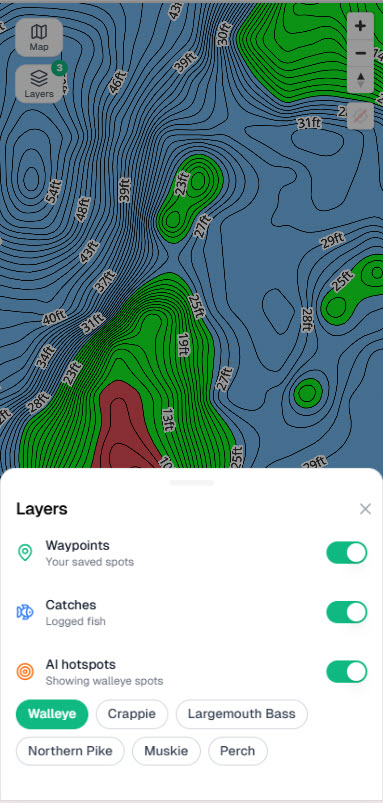
What to do: This is where depth-specific structure data earns its keep. You're not just looking for "the breakline" anymore — you're looking for the exact stretch of that breakline where a hard-bottom transition, inside turn, or subtle point breaks up the otherwise uniform drop. That's the kind of detail that's easy to miss on a basic map and much easier to spot when you can isolate a depth band and see the shape of the bottom at a glance.
Late Ice: Fish Start Staging for the Spawn
As the days lengthen and the first meltwater starts working into the system, fish begin staging for the open-water spawn, and location starts to shift again — often back toward the areas you'd expect to find them at first ice, plus feeder-creek mouths, inlets, and the shallow flats that will warm first once the ice goes out. Pike push shallow first, followed by walleye and panfish as the season turns.
Late ice is also when conditions get the most unpredictable, and there's a genuinely useful piece of DNR guidance that catches a lot of anglers off guard: new, clear ice is often stronger than old, late-season ice at the same thickness. A foot of rotten, honeycombed March ice can be less safe than four inches of solid ice in December. Thickness alone doesn't tell the whole story once the season turns.
What to do: Fish the same transition areas that produced at first ice, but hold a shorter leash on how far you're willing to walk or drive, and lean harder on current local ice reports than on the calendar. Late ice rewards flexibility more than any other stretch of the season.
Panfish Through the Season
Crappie and bluegill are what most Minnesota anglers actually spend their ice time on, and they move on a different schedule than walleye do.
Crappie start the season in green weeds in 6 to 12 feet, then pull off to suspend over the deepest basin water on the lake once the weeds die back — often sitting 10 to 20 feet down over 30 feet of water, nowhere near bottom. That suspension is the whole game. If you're fishing bottom in January you're fishing under them. They feed hardest in the last hour of light and the first hour after dark, more reliably than at dawn.
Bluegill hold tighter to structure than crappie do and stay closer to bottom, working deep weed edges early and then mud flats and basin transitions through mid-winter, where they root for bloodworms. They're an all-day fish more than a low-light fish, which makes them the better target when you're out with kids or waiting on a walleye window.
Late ice flips both. Crappie and bluegill push back shallow toward the same bays and creek mouths they used at first ice, often in water so shallow you can see the bottom through the hole — some of the best panfish fishing of the year, and the shortest window.
🔄 Where Open-Water Structure Knowledge Applies — and Where It Doesn't
It applies to:
- Humps, points, saddles, and breaklines. Fish relate to these the same way in January as they do in July — the structure itself doesn't change, only how tight fish sit to it and how far they range from it.
- Depth transitions. A sharp break still concentrates fish more reliably than a gradual taper, ice or no ice.
- Weed flats, within reason. Green, living weeds still hold baitfish and predators through early winter, though weed quality degrades as the season goes on.
It doesn't apply cleanly to:
- Current areas. Inlets, narrows, and current-affected zones that might hold summer fish are also the least predictable and least safe ice, so they deserve extra caution rather than extra confidence.
- Wind-driven patterns. Summer location often leans on wind pushing bait and oxygen into an area. Under a foot of ice and snow, that mechanism is gone, so a spot that was money on a windy August afternoon isn't automatically a winter spot.
- Surface temperature cues. There's no surface temp read to work off of once you're standing on solid water — depth and structure become your primary read instead of the conditions-based cues you'd lean on in open water.
🥶 Minnesota Ice Safety: The Framework Every Angler Should Know
There's no such thing as perfectly safe ice — that's true all season, on every lake, no matter how thick it looked yesterday. Ice thickness can vary by close to a foot within a few yards of the same lake, especially near pressure ridges, inlets, and areas with current or aquatic vegetation. Always check thickness yourself with a spud bar, auger, or tape measure — Minnesota DNR ice safety guidance recommends checking roughly every 150 feet as you move across a lake, not just drilling one hole and trusting it for the whole outing. The framework below is a summary — the DNR site is the authoritative, continuously-updated source, and it's worth bookmarking directly.
Minimum thickness guidelines
These assume solid, clear, new ice:
| Activity | Minimum Ice Thickness |
|---|---|
| Walking / ice fishing on foot | 4 inches |
| Snowmobile or small ATV | 5–7 inches |
| Side-by-side ATV | 7–8 inches |
| Car or small pickup | 9–12 inches |
| Full-size truck | 13–17 inches |
A few things worth knowing on top of the table:
- New ice is usually stronger than old ice. Four inches of solid, clear, newly-formed ice can support a person on foot, while a foot or more of old, partially-thawed late-season ice may not. Don't let a big number from earlier in the season give you false confidence in March.
- White or "snow ice" — the cloudy layer that forms when snow melts and refreezes on top — is roughly half as strong as clear ice, so double the thickness guideline when you're dealing with it.
- Ice is rarely uniform across a lake. A stretch that's over a foot thick in one spot can be just an inch or two a short walk away, particularly near inlets, points, bridges, and anywhere with moving water underneath.
- If you're parking a vehicle on the ice for any length of time, keep it at least 50 feet from other vehicles and move it periodically — a stationary load needs more margin than the standard guideline.
If you go through the ice
Work out this plan before you ever need it:
- Don't panic, and don't remove your winter clothing. Heavy clothes trap air and help you float — this is especially true of a snowmobile suit.
- Turn back toward the direction you came from. That's almost always the strongest ice.
- Get your arms and hands up onto the unbroken surface and use ice picks (or anything sharp — screwdrivers, nails) to get traction.
- Kick your legs to drive your body up horizontally onto the ice, the same motion as a swimming kick, rather than trying to pull straight up.
- Once you're out, don't stand up. Roll away from the hole to spread your weight, then crawl or roll to solid ice before standing.
- Get to warmth immediately and seek medical attention for any significant cold exposure — cold blood returning to the heart as you re-warm carries its own risk and shouldn't be brushed off.
If it's someone else who's gone through: call 911 first, resist the urge to run to the edge of the hole yourself, and work through reach–throw–row–go in that order — reach with a rope or pole from solid ice, throw something that floats, use a light boat pushed ahead of you if available, and only go out onto the ice yourself as an absolute last resort.
Carbon monoxide in shelters
This one's specific to ice season and doesn't get talked about enough: propane heaters burn oxygen and produce carbon monoxide as a byproduct, and in a closed, poorly-ventilated shelter that gas can build up without any smell or warning sign. Every heated shelter should have vents near the top and bottom that stay clear of snow and ice, and a carbon monoxide detector is genuinely worth the cost — CO poisoning can feel like nothing more than the flu setting in until it's serious.
None of this replaces checking conditions yourself before you go. Local bait shops, resorts, and ice-road operators on the lake you're headed to almost always have a better current read than any guide — including this one — can offer.
🛠️ How Fish Guide Pro Fits Into an Ice Season
The single biggest difference between a good day and a wasted one on unfamiliar ice is knowing the shape of the lake before you drill. That's the part you can do from your kitchen table the night before. Here's what's actually useful for ice season specifically, not the whole feature list — and to be clear about what this isn't, none of it tells you what the ice looks like on your lake today. Nothing static should.
-
HD Contour Maps give you the bathymetric picture — humps, points, breaklines, and flats — before you ever drill a hole, with 1-ft resolution and depth shading that make a subtle transition or saddle area obvious at a glance instead of something you have to squint at contour lines to find.
-
AI Hotspot Finder layers structure with seasonal patterns to flag likely locations for your target species, so a new lake doesn't mean hours of blind drilling.
-
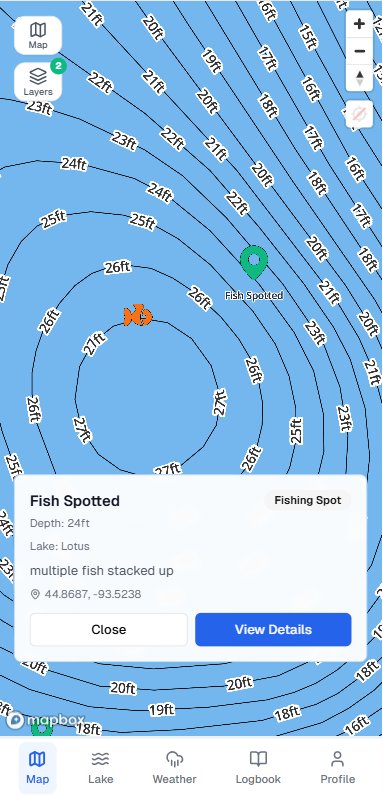
Waypoints & Catch Log let you mark the exact holes that produced, so a good spot from first ice is easy to find again come mid-winter.
-
Lake Info & Regulations surfaces slot limits and special regs before you drill, so a lake like Mille Lacs doesn't turn into a surprise at the fillet table.
-
Fishing Score & Bite Timeline grades the day and calls out the dawn/dusk windows that matter most at first ice, so you know when to actually be standing over the hole.
The lake underneath the ice is the same lake you fished all summer. The prep work carries over — and every minute you're not spending lost on a new lake is a minute you get to actually spend with whoever's out there on the ice with you. The rest is up to conditions, patience, and a good spud bar.
❓ FAQ
When does ice fishing season start in Minnesota? It varies by region — far northern lakes like Lake of the Woods often see safe ice by late November to early December, while southern Minnesota lakes typically aren't fishable until late December or January. Always confirm current local conditions rather than going by a calendar date.
How thick does ice need to be to fish on foot? DNR guidance calls for a minimum of 4 inches of solid, clear ice for walking or ice fishing on foot. That number goes up for any vehicle, and should be doubled for white or snow-covered ice.
Is old ice safer than new ice? Not necessarily. New, clear ice is often stronger than old, deteriorating ice at the same thickness — a foot of rotten late-winter ice can be less safe than four inches of solid early-season ice.
What gear do I need to start ice fishing? At minimum: an auger to make a hole, a short ice rod, a spud bar to test ice as you walk, and warm layers with ice cleats. A shelter and a flasher aren't required to catch fish, but a flasher will change your results more than any other single purchase.
Where do fish go under the ice? To the same structure they used in open water — humps, points, breaklines, and flats — but they sit tighter to it and move less. Walleye work shallow bays near deep water at first ice, then slide out to main-lake breaks in 22 to 35 feet by mid-winter. Crappie start in green weeds and then suspend over the deep basin, often well off the bottom.
When do ice shelters need to come off the lake in Minnesota? Deadlines vary by region: the southern two-thirds of the state by March 2, the northern third by March 16, and Minnesota-Canada border waters (including Lake of the Woods) by March 31. Confirm the exact current-season dates before hauling out.
Looking for ice fishing specifics on a particular Minnesota lake? Check any lake yourself in Lake Finder for season-by-season structure and current DNR survey data.
Every moment on the water is too good to waste standing over the wrong hole. Try Fish Guide Pro free and check the depth contours and DNR data on your lake before you ever drill.