The best ice fishing lakes in Minnesota depend on what you want to catch. A great walleye lake can be a poor crappie lake, and the biggest bluegill on this list come from a lake most walleye anglers have never fished. So instead of one ranked list, we picked 12 lakes by species, using the most recent Minnesota DNR survey numbers for each one.
Every lake below links to its current regulations, and every survey stat comes from the DNR's own lake surveys. For when ice fishing starts in your part of Minnesota and how to stay safe on early ice, see our Minnesota Ice Fishing Guide and ice thickness chart.
Jump to a section:
Minnesota ice fishing lakes at a glance
| Lake | Best for | Region | Nearest town | Winter access |
|---|---|---|---|---|
| Upper Red | Walleye (numbers) | Northwest | Waskish | Resort ice roads |
| Vermilion | Walleye (numbers) | Northeast | Tower | Public access, resorts |
| Leech | Walleye (size) | North-central | Walker | Resort ice roads |
| Mille Lacs | Yellow perch | Central | Garrison | Resort ice roads |
| Winnibigoshish | Yellow perch | North-central | Bena | Resort ice roads |
| Cut Foot Sioux | Crappie | North-central | Deer River | Public access |
| Clear (Meeker Co.) | Crappie | Central | Watkins | Public access |
| Lake of the Woods | Northern pike, walleye, sauger | Far north | Baudette | Resort ice roads, rental houses |
| Prior | Northern pike | Twin Cities | Prior Lake | Public access |
| Big Stone | Bluegill | West | Ortonville | Public access |
| Waconia | Bluegill, sunfish | Twin Cities | Waconia | Public access, city winter access |
| Minnetonka | Pike, panfish | Twin Cities | Mound | Public access |
Ice fishing near you in Minnesota: lakes by region
Looking for ice fishing near you? Start with the part of Minnesota you're closest to. Drive times are approximate, from each city to the nearest public access or resort area.
| If you're near… | Closest lakes on this list | Drive time |
|---|---|---|
| Minneapolis–St. Paul | Prior Lake, Lake Minnetonka, Lake Waconia | 30–45 min |
| St. Cloud | Clear Lake (Watkins); Mille Lacs | about 30 min; about 1.5 hr |
| Brainerd–Baxter | Mille Lacs; Leech Lake | about 45 min; about 1 hr |
| Grand Rapids | Cut Foot Sioux; Lake Winnibigoshish | about 45 min each |
| Bemidji | Leech Lake; Upper Red Lake | about 45 min; about 1 hr |
| Duluth and the Iron Range | Lake Vermilion | about 1.5 hr from Duluth |
| Morris and west-central MN | Big Stone Lake | about 1 hr from Morris |
| Baudette, Roseau, International Falls | Lake of the Woods | on the lake to about 1.5 hr |
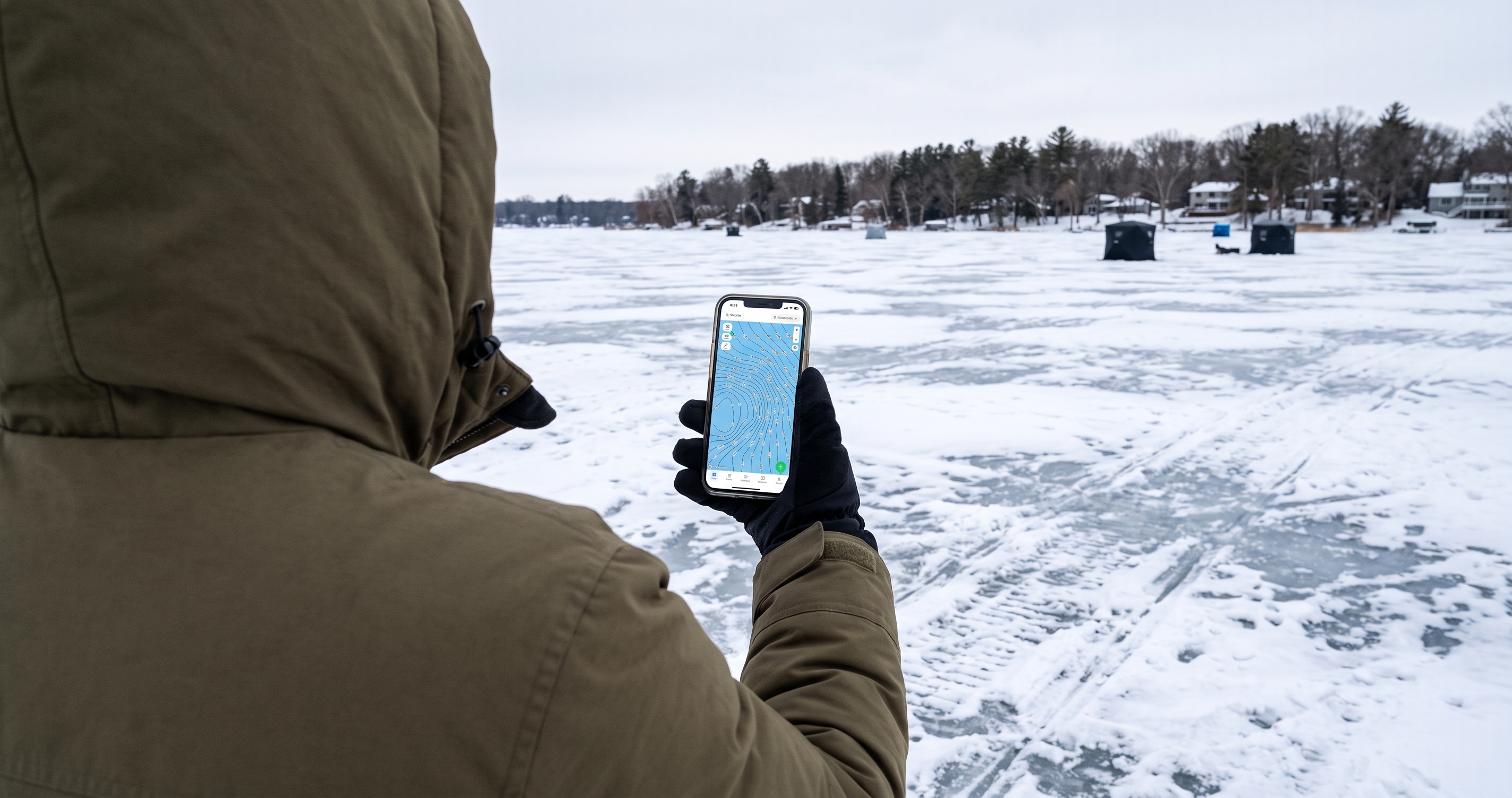
Wherever you are in Minnesota, the Fish Guide Pro Lake Finder shows the lakes closest to you with contours, DNR survey data, and regulations.
Walleye
If you want walleye through the ice, start with these three. Upper Red and Vermilion are the numbers lakes, both with some of their best DNR gill net catches in years in 2025. Leech is the pick for a bigger fish.
Upper Red Lake ice fishing
Beltrami County, near Waskish · 119,295 acres total (about 48,000 open to state anglers) · shallow, flat basin
Upper Red has one of the highest walleye catch rates in Minnesota. The 2025 DNR survey netted 50.9 walleye per gill net, and the population is loaded with young fish from the 2022 year class, now 8 to 17 inches. Expect lots of action and a lot of fish right around the 17-inch mark, so measure carefully.
There's almost no structure here. Walleye roam a big, shallow bowl, so you find them by moving and watching for subtle hard-bottom changes, not by hunting a breakline. Resorts around Waskish on the east side plow ice roads and rent houses once the ice allows.
Red also gives you two bonuses. Perch grow fast here: 59% of the perch netted in 2025 were over 9 inches. And trap nets after ice-out have turned up pike to 44 inches, with tremendous numbers over 36.
**Before you go:** the western part of Red Lake is reservation water and closed to non-band members. The DNR recommends state anglers stay east of 94° 43' 12.0". Red also has its own winter walleye limit, separate from open water. [Check current Upper Red regulations](/features/lake-regulations/).Lake Vermilion ice fishing
St. Louis County, near Tower · 39,302 acres · max depth 74 ft
Vermilion's 2025 survey showed one of its highest walleye catch rates in more than four decades, 18.7 per gill net. Fish from 12 to 15 inches are especially abundant, and walleye over 20 inches are common enough to give you a real shot at a big one.
Vermilion fishes like two lakes. East Vermilion usually holds more walleye; West Vermilion tends to produce bigger ones. At first ice, the bays freeze well before the main basins. Start on rock points at the mouths of bays that sit next to deep water.
Vermilion has a protected slot on walleye. [Check current Vermilion regulations](/features/lake-regulations/).Leech Lake ice fishing
Cass County, near Walker · 103,498 acres · max depth 135 ft
Leech is the walleye lake for anglers who'd trade some numbers for size. The historically large 2021 year class is now 17 to 21 inches, and 24% of the walleye in the 2025 DNR survey were over 20 inches. The catch rate is lower than on Upper Red or Vermilion (5.8 walleye per gill net), so expect fewer, bigger fish.
Walker Bay and the other big bays lock up first. At first ice, fish the 8- to 15-foot edges and the bars or humps closest to those bays. As the main lake freezes, walleye slide out to the main-lake bars. Leech is a good perch lake too: 46% of the perch netted in 2025 were 8 inches or longer.
Leech has its own walleye limit with only one over 20 inches, plus 5-fish limits on crappie and sunfish. [Check current Leech Lake regulations](/features/lake-regulations/).For where walleye sit in the first weeks of ice on all three of these lakes, see First-Ice Walleye in Minnesota.
Yellow perch
Jumbo perch are the reason a lot of Minnesota anglers own an ice house. These two big lakes are both trending up.
Mille Lacs ice fishing for perch
Mille Lacs County, near Garrison · 128,345 acres · max depth 40 ft
Everyone knows Mille Lacs for walleye, but perch are the winter story right now. The 2025 winter perch harvest was the highest since 2011, after good ice let anglers reach the deeper offshore flats. Fall nets in 2025 found perch from the 2018 through 2024 year classes near or well above median, and age-1 perch at the highest level ever recorded. More of those fish will grow past the 9-inch keeper mark this winter.
Winter perch here are a mud-flat game. Look for the transitions where the deep mud basin meets gravel or rock, and move until you find a school. Expect walleye in the mix too: winter walleye catch rates in 2025–26 were the highest on record, though most were small fish from the 2024 year class.
Mille Lacs has its own perch limit, plus special walleye, pike, and burbot rules that change often. [Check current Mille Lacs regulations](/features/lake-regulations/).Lake Winnibigoshish ice fishing
Cass County, near Bena · 56,506 acres · max depth 76 ft, but averages just 15 ft
Winnie has a long history as a jumbo perch lake, and the perch are coming back. Gill net catches hit a record low in 2022, but three straight years of good reproduction have pushed numbers up since. Growth has also sped up, and some perch now reach keeper size two years earlier than average.
Fish Winnie like the big shallow flat it mostly is. Work the long, tapering breaks and the sand-to-rock transitions, especially near the few spots where the bottom drops. Walleye and pike feed heavily on these same perch, so you'll often find both on the same structure. Burbot (eelpout) are a popular after-dark ice target here as well.
Winnie and its connected waters, including Cut Foot Sioux, share a walleye slot and a 5-fish sunfish limit. [Check current Winnibigoshish regulations](/features/lake-regulations/).Crappie
Winter crappie fishing is usually a numbers game. These two lakes go a step further: Cut Foot Sioux for size, and Clear for a consistent bite within a day trip of the Twin Cities.
Cut Foot Sioux Lake ice fishing
Itasca County, near Deer River · 2,773 acres · max depth 76 ft
Cut Foot Sioux is the place to go if you'd rather catch five big crappie than twenty small ones. A 2025 DNR trap net study found black crappie averaging 10.3 inches, with the largest at 13.1. They grow fast here, too: by age 6, the average crappie is 11.6 inches. The DNR also cites Cut Foot's high-quality sunfish size structure as the reason the Winnie system now has a 5-fish sunfish limit.
Cut Foot is deep and clear for its size. That means winter crappie usually suspend over the deep basin, often well off the bottom. A flasher is close to mandatory: find the fish's depth first, then fish just above them. Expect the best bite in the last hour of light.
Cut Foot connects to Lake Winnibigoshish and shares its walleye and sunfish regulations. [Check current Cut Foot Sioux regulations](/features/lake-regulations/).Clear Lake (Watkins) ice fishing
Meeker County, near Watkins · 529 acres · max depth 23 ft
The DNR's 2026 area outlook names Clear as one of its most consistent crappie lakes, in open water and through the ice. The last full DNR survey (2021) found good numbers of crappie, with 8- to 9-inch fish plentiful and the biggest at 11 inches. White and hybrid crappie show up too.
Clear is small and shallow, so it's easy to fish. Start on the deep weed edge in the first weeks of ice, then check the deepest basin water as the light fades. It's also a sleeper pike lake: pike in the 2021 survey averaged 25 inches, and the biggest was 35. Set a tip-up on the weed edge while you jig crappie.
Statewide regulations apply on Clear. Check current regulations.
Northern pike
For tip-ups, these two lakes give you a real shot at a big pike instead of a pile of hammer handles.
Lake of the Woods ice fishing
Lake of the Woods County, near Baudette and Long Point · 725,583 acres (over 300,000 on the Minnesota side)
Most people come to Lake of the Woods in winter for walleye and sauger, and it delivers. The 2025 DNR survey netted 15.5 walleye and 17.1 sauger per gill net, and both species are meeting the DNR's long-term management goals. Walleye from 11 to 25 inches were above average.
What many anglers don't realize is that Lake of the Woods is also managed for trophy pike. The DNR specifically manages for a strong share of fish over 40 inches, and 2025 fall nets caught pike up to 42.4 inches, averaging 26.2. Pike are easiest to target at first ice in the shallow bays along the south shore, and at late ice near river mouths as they stage to spawn. Set tip-ups with big suckers there. Midwinter walleye and sauger are usually out on the deeper mud flats, away from the pike water.
This is also the easiest big lake to fish if you're new to ice. Resorts plow ice roads for miles off the south shore and rent heated day and sleeper houses already set over fish. Jumbo perch are a bonus, too: nearly half the 2025 perch catch was 9 to 11 inches.
Walleye and sauger share a combined limit with a protected walleye slot, pike have a protected slot, and Four-Mile Bay and the Rainy River have separate rules from the main lake. [Check current Lake of the Woods regulations](/features/lake-regulations/).Prior Lake ice fishing
Scott County, near Prior Lake, about 25 miles south of Minneapolis · Lower Prior 957 acres · max depth 54 ft
Prior Lake is quietly becoming a big-pike lake. The 2024 DNR survey caught pike averaging 22.8 inches and up to 36.3, and the DNR notes recent surveys have turned up several fish over 36 inches, which Prior was never known for. Numbers are about average for similar lakes, so this is a quality bite, not a numbers one.
The water is clear, so pike cruise the deep weed edges where the panfish hold. Set tip-ups along those edges and jig panfish between flags. Prior is one of the west metro's Quality Sunfish Initiative lakes, and nearly 25% of the bluegill sampled in 2024 were over 7 inches.
Prior has a 5-fish daily limit on crappie and sunfish (Upper and Lower Prior). Public access is on the north side off County Road 42. [Check current Prior Lake regulations](/features/lake-regulations/).Bluegill and sunfish
Bluegill are the best fish for a family day on the ice: they bite all day, they're close to shore, and they're great to eat. One of these lakes is about size, the other about numbers.
Big Stone Lake ice fishing
Big Stone County, near Ortonville · 12,610 acres (shared with South Dakota) · max depth 16 ft
Big Stone has changed a lot in recent years. The water has cleared, rooted weeds have spread, and bluegill numbers have climbed. The DNR's 2025 survey notes the bluegill grow fast here, and anglers frequently catch them over 9 inches. That's a true trophy bluegill in Minnesota.
This is a long, shallow, weedy lake, so winter bluegill hold in and around the weed beds rather than deep basins. Small tungsten jigs tipped with waxworms are the standard. You'll also run into quality black crappie, perch (more fish over 10 inches than in recent surveys), and walleye up past 25 inches.
Big Stone is a Minnesota–South Dakota border water, so border water regulations apply. Please release big bluegill: a 9-incher takes years to replace. [Check current Big Stone regulations](/features/lake-regulations/).Lake Waconia ice fishing
Carver County, near Waconia, about 35 miles west of Minneapolis · 3,083 acres · max depth 37 ft
If you want to fill a bucket, Waconia is the lake. The 2025 DNR survey caught 90.5 bluegill per trap net, well above the expected rate for similar lakes. Most are 5 to 6 inches, but nearly a third run 6.5 to 7.5 inches, which is a good meal-sized fish. Pumpkinseed sunfish are also abundant and run bigger than the bluegill, up to 8 inches.
Waconia is more than a panfish lake. Walleye numbers were above average in 2025, averaging 18.1 inches, and pike numbers hit their highest level in 30 years, with over 40% longer than 28 inches. The city maintains a winter access on the southwest side off Lakeview Terrace Blvd.
Waconia has a 16-inch minimum on walleye. [Check current Waconia regulations](/features/lake-regulations/).Ice fishing near Minneapolis and St. Paul
Not every ice trip needs a three-hour drive. Two of the picks above are Twin Cities lakes: Lake Waconia for bluegill and Prior Lake for pike. Lake Minnetonka is the third. It's big and deep, so it usually locks up later than the small metro lakes; check it yourself before you go.
Lake Minnetonka ice fishing
Hennepin County, near Mound · 14,216 acres · max depth over 100 ft
Minnetonka is the metro's big multi-species ice lake. Pike are abundant and reproduce naturally; the 2022 DNR survey's biggest was 35.4 inches. Bluegill and black crappie are abundant too, with bluegill to almost 9 inches and crappie to 12. Walleye are few, but the ones you find run big, averaging 19.1 inches and 2.6 pounds.
Minnetonka is really a chain of connected bays that fish differently. The Northwest Bays held the biggest pike in 2022, the Lower Lakes held the biggest walleye, and the Upper Lakes had the best perch size. For a bay-by-bay breakdown, see our Lake Minnetonka Fishing Guide. Statewide regulations apply. Check current regulations.
FAQ
What are the best ice fishing lakes in Minnesota? It depends on the species. For walleye numbers, Upper Red and Lake Vermilion both posted some of their best DNR gill net catches in years in 2025, and Leech is the pick for bigger fish. For jumbo perch, Mille Lacs and Lake Winnibigoshish are on the rise. For pike, Lake of the Woods is managed for trophy fish over 40 inches, and Prior Lake is the metro sleeper. For panfish, Cut Foot Sioux and Big Stone produce unusually large crappie and bluegill.
Where can I go ice fishing near me in Minnesota? Start with the region table above. In the Twin Cities, Prior Lake, Lake Minnetonka, and Lake Waconia are all within about 45 minutes of Minneapolis. Near St. Cloud, Clear Lake by Watkins is about 30 minutes away. Up north, Brainerd, Bemidji, and Grand Rapids are each within about an hour of Mille Lacs, Leech, Upper Red, or Winnibigoshish.
What are good ice fishing lakes in MN near the Twin Cities? Lake Waconia, Lake Minnetonka, and Prior Lake are all within about 40 miles of Minneapolis. Waconia is the best for numbers of bluegill, Minnetonka has abundant pike and panfish, and Prior Lake is producing more big pike in recent surveys.
Which Minnesota lake is best for a first ice fishing trip? Lake of the Woods. Resorts plow ice roads and rent heated fish houses already set over fish, so you can fish well without owning a shelter, an auger, or electronics.
When does ice fishing start on these lakes? Northern lakes like Lake of the Woods and Upper Red usually have fishable ice first, often by late November or early December. Metro lakes typically follow by mid-to-late December. See our Minnesota Ice Fishing Guide for timing by region, and always check ice thickness yourself before heading out.
The lake you pick matters, but where you drill on it matters more. Fish Guide Pro puts 1-foot contours, the latest DNR survey data, and current regulations for every lake on this list in one app, so you can find the breaks, weed edges, and mud flats before you leave the house. Find ice fishing near you in Lake Finder →