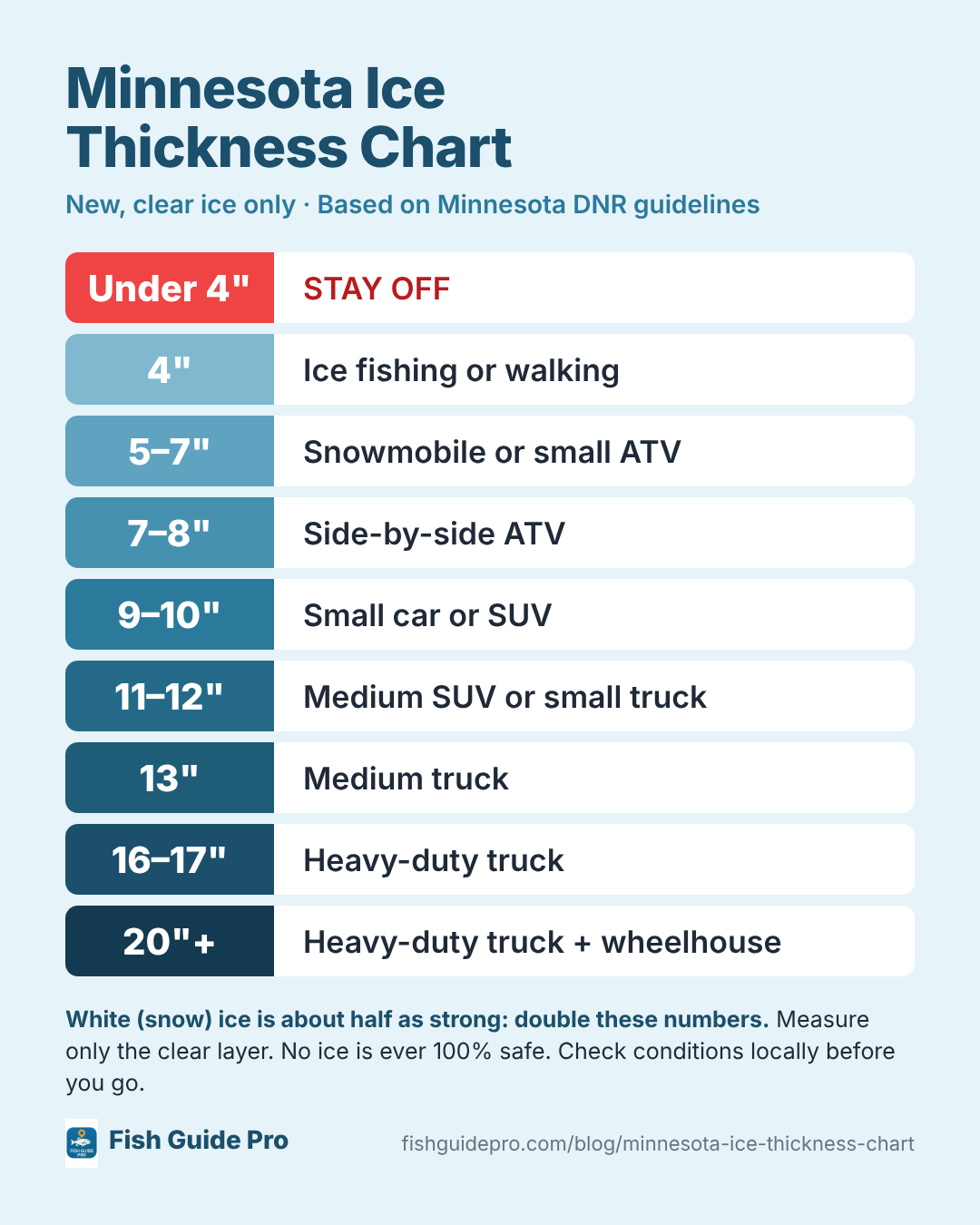
This Minnesota ice thickness chart shows how thick ice needs to be before you walk, ride, or drive on it, based on the Minnesota DNR's current guidelines. Stay off anything under 4 inches. Keep in mind the DNR doesn't measure ice on any lake, so checking it is up to you.
| Ice thickness | What it can hold |
|---|---|
| Under 4" | Stay off |
| 4" | Ice fishing or walking |
| 5–7" | Snowmobile or small ATV |
| 7–8" | Side-by-side ATV |
| 9–10" | Small car or SUV |
| 11–12" | Medium SUV or small truck |
| 13" | Medium truck |
| 16–17" | Heavy-duty truck |
| 20"+ | Heavy-duty truck with a wheelhouse shelter |
No ice is ever 100% safe. These numbers assume solid, clear ice and average equipment weight. Double them for white ice. Source: Minnesota DNR ice thickness guidelines.
Last checked against Minnesota DNR guidelines: October 26, 2026.
No ice is ever 100% safe. Check conditions locally before you go.
Ice thickness also changes fast across one lake. The DNR notes ice can be two feet thick in one spot and an inch thick a few yards away. Treat the chart as a minimum, check as you go, and talk to a local bait shop or resort before you head onto an unfamiliar lake.
Jump to a section:
Clear ice vs. white ice: why color matters
The chart only applies to clear ice. Before you trust any measurement, look at what kind of ice you're standing on.
| Ice type | What it looks like | How strong |
|---|---|---|
| Clear (blue or black) ice | See-through; looks blue or black looking down into the water. Forms early in the season on calm water. | Strongest. The chart applies. |
| White (snow) ice | Cloudy, milky, full of air bubbles. Forms when snow on top melts and refreezes. | About half as strong. Double the chart. |
| Honeycomb (rotten) ice | Late-season ice broken into vertical columns; shatters easily. | Stay off. The chart doesn't apply. |
Measure only the clear layer. A hole often shows clear ice on the bottom and a white layer on top. If your auger hole shows 10 inches of clear ice under 5 inches of white, you have 10 inches of real ice, not 15.
New ice is usually stronger than old ice. Four inches of new, clear December ice can hold a person on foot. A foot of late-March ice that's been thawing and refreezing may not. Don't let a big number from earlier in the season carry over to late ice.
Snow makes everything harder. Snow insulates the ice and slows freezing, adds weight the ice has to carry, and hides cracks, holes, and pressure ridges. A lake with deep early snow often has thinner, weaker ice than the calendar suggests.
Booming and cracking noises aren't necessarily dangerous. They mean the ice is expanding and contracting as the temperature changes. Visible cracks, wet spots, and slush on top deserve more caution than the sound.
How to check ice thickness: spud bar, auger, and tape
A spud bar is the most important ice fishing tool you'll own, and it's the one most people leave in the sled. Here's how to check ice the right way.
1. Start at shore
Check the ice right where you step on, not just once you're out. Ice near shore and around launches gets the most traffic and can hide thin spots under snow.
2. Use a spud bar as you walk
A spud bar (or ice chisel) is a heavy steel rod with a sharp blade on the end. On early and late ice, carry it in your hands, not in the sled. Stab the ice in front of you before each step. If the bar punches through or opens a big crack in one or two jabs, stop and turn around.
The DNR's point here is worth repeating: if you're walking on 4 to 6 inches of ice, you'll likely find spots under 4 inches on the same lake. The spud bar is how you find them before your boots do.
3. Drill and measure
Every so often, drill a hole and measure. The DNR recommends checking about every 150 feet.
- Ice auger: hand, electric, or gas augers all work.
- Cordless drill: a long 5/8-inch wood auger bit on a drill of at least 7.2 volts will go through 8 inches of ice in under 30 seconds. The spiral flutes on a wood bit pull the chips out; a metal bit won't.
- Tape measure: drop it in the hole, hook the bottom edge of the ice, pull it tight, and read it at the surface. An ice skimmer with inch marks on the handle works too.
Don't guess thickness by how easily the bar or drill goes through. It happens so fast that it's easy to overestimate.
4. Recheck as conditions change
Ice changes with temperature, wind, sun, and snow, sometimes within a day. Recheck on every trip, even on a lake you fished last weekend, and don't trust someone else's tracks, holes, or social media posts.
Tip: In the Fish Guide Pro app, drop a waypoint with a note at each spot you check ("6 in clear, Dec 12"). You'll have a record of where the good ice was for your next trip, and you can share the waypoint with whoever's coming with you.
Where ice is thinnest on a Minnesota lake
The ice that gets people in trouble usually isn't in the middle of a basin. It's in a handful of predictable spots, and many of them are the same spots fish like.
- Moving water. Inlets, outlets, narrows, river mouths, culverts, and anything under a bridge. Current keeps ice thin all winter.
- Points and bottlenecks. Wind and current funnel through these, and they often freeze last.
- Docks, rocks, logs, and shoreline structure. These absorb sun and warm the water around them, leaving thin ice or open water nearby.
- Springs. Groundwater coming up from the bottom keeps a patch of ice thin, and you can't see it from the surface.
- Heavy weed beds and stream inlets. Decaying plants release gas that melts bell-shaped holes up from underneath. These gas holes can be several feet wide below and only inches wide at the surface, often hidden under snow.
- Pressure ridges. Long buckled seams where ice sheets collide. The ice next to a ridge is often flooded, thin, or open, and new ridges can form in a few hours, even across the path you walked out on.
- Shelf ice on big lakes. On Upper Red, Leech, Lake of the Woods, and Mille Lacs, wind can pile broken ice into stacks that look solid but are full of air pockets over open water. Stay off.
- Under snowdrifts. Snow insulates and weighs down the ice under it.
- Where fish school or birds gather. Schools of fish can bring up warmer water, and flocks of geese sitting on the ice can thin it.
- Near shore at late ice. In spring, shallow water near shore warms first, so the ice there often goes bad before the middle of the lake.
What this looks like in real life: in January 2026, a warm-up hit the Brainerd lakes, and the local guide service reported several ATVs through the ice on North Long and vehicles through on Pelican. Their advice was to steer well away from current, points, narrows, and backwater areas until the ice firmed up again.
Wind matters on big lakes. On early ice on lakes like Upper Red, a strong offshore wind can break the sheet you're on away from shore. If the wind picks up or changes direction while you're on early ice, head in.
What to carry: ice picks, spud bar, and the rest
This gear costs less than a new flasher, and every piece has a specific job if something goes wrong.
- Foam life jacket or float suit. This is the most important item. Most people who die after falling through ice drown; they don't die of hypothermia. A float suit or foam jacket keeps your head up while you get your breathing under control. Use foam, not inflatable: inflatables may not inflate reliably in the cold. Never wear one while driving inside an enclosed vehicle on the ice, because it makes escaping a sinking car much harder.
- Ice picks. Wear them around your neck, over your jacket, where you can grab them. Pulling yourself onto smooth, wet ice with numb hands is nearly impossible without them.
- Spud bar (ice chisel). For checking ice ahead of you on every early- and late-ice trip.
- Auger or cordless drill, plus a tape measure. For measuring the ice, not just fishing it.
- Ice cleats. New clear ice is slick. A fall on thick ice breaks wrists and tailbones; a fall on thin ice can put you through it.
- Rope. If someone else goes through, a throw rope lets you help from solid ice. In a pinch, jumper cables or a long branch work too.
- Whistle. Cold shock can make it hard to yell. A whistle carries farther and costs less energy.
- Phone in a waterproof case, or a personal locator beacon. Cell service on a big lake is spotty. A satellite beacon can send your location and an SOS without it.
Best of all, bring a buddy, and always tell someone which lake you're on and when you'll be back.
If you go through the ice
Work out this plan before you ever need it. Cold water makes you gasp and hyperventilate at first. Once you get your breathing under control, you have roughly 10 minutes of useful strength to get yourself out.
- Don't panic, and keep your winter clothes on. Your clothes trap air and help you float, especially a float suit.
- Turn back the way you came. That's the ice that already held you.
- Get your arms onto the ice and dig in your picks.
- Kick hard and slide forward, like swimming, so you come out flat instead of trying to pull straight up.
- Once you're out, don't stand up. Roll away from the hole to spread your weight, then crawl to solid ice.
- Get warm right away: shelter, dry clothes, and warm drinks without alcohol or caffeine. Get medical help for any serious cold exposure.
If someone else goes through
Stay where you are. Running to the hole usually adds a second person to the water. Call 911 first, then follow reach, throw, row, go: reach with a pole or branch from solid ice, throw a rope or anything that floats, push a light boat ahead of you if one is available, and only go out yourself as a last resort. If you throw a rope, have them tie it around themselves before they get too tired to hold on, then pull while they kick. If you start sliding toward the hole, let go and try again.
Carbon monoxide in ice shelters
Propane heaters use up oxygen and make carbon monoxide. In a closed shelter, CO can build up with no smell or warning, and early poisoning feels a lot like the flu. Keep vents near the top and bottom of the shelter open and clear of snow and ice, and run a battery CO detector in every heated shelter.
Parking vehicles on the ice
Frozen lakes aren't parking lots. Park cars, pickups, and SUVs at least 50 feet apart, and move them every two hours so they don't slowly sink. Don't park along the shore by the access either; if the ice isn't thick enough to drive out on, it isn't thick enough to park on.
A vehicle left in one spot for more than two hours needs thicker ice than the main chart:
| Parked load (2 hours to 7 days) | Minimum ice |
|---|---|
| Person standing | 6" |
| Snowmobile and rider (under 1,100 lbs) | 10" |
| Loaded vehicle, 1,100–2,200 lbs | 13" |
| Loaded vehicle, 2,200–4,400 lbs | 16" |
| Vehicle, 4,400–6,600 lbs | 18" |
| ¾-ton 4x4 (up to 11,000 lbs) | 22" |
Tip: drill a hole next to your parked vehicle. If water starts flooding up out of it, the ice is sinking under the weight and it's time to move.
FAQ
How thick does ice need to be to walk on? At least 4 inches of new, clear ice for walking or ice fishing on foot, according to the Minnesota DNR. Stay off anything thinner, and double that for white or snow ice.
How thick does ice need to be to drive a truck on? The DNR's guidelines call for 11–12 inches of clear ice for a medium SUV or small truck, 13 inches for a medium truck, and 16–17 inches for a heavy-duty truck. A truck pulling a wheelhouse needs 20 inches or more. Parked vehicles need more ice than moving ones.
What is a spud bar used for in ice fishing? A spud bar, or ice chisel, is a heavy steel bar with a sharp blade used to test ice as you walk. You stab the ice ahead of you before each step; if it breaks through in one or two blows, the ice is too thin. It's the most important safety tool on early and late ice.
Is white ice safe? White ice, or snow ice, is only about half as strong as clear ice because it's full of air bubbles. Double the thickness guidelines when you're on it, and measure only the clear layer underneath when you drill.
Does the DNR check ice thickness on Minnesota lakes? No. The Minnesota DNR doesn't measure ice on any lake. Checking ice is up to each person, so ask a local bait shop or resort about conditions and measure the ice yourself.
Good ice is only half of a good day. Once you know it's safe to get out there, the next question is where to drill. Fish Guide Pro shows 1-foot contours, DNR survey data, and regulations for Minnesota lakes, and you can download maps for offline use and drop a waypoint at every spot you check. Try Fish Guide Pro free.
For when ice usually forms in your part of the state, see our Minnesota Ice Fishing Guide. For where to go once it's safe, see the best ice fishing lakes in Minnesota.
No ice is ever 100% safe. Check conditions locally before you go.
Sources
- Minnesota DNR: General ice thickness guidelines
- Minnesota DNR: How to check ice thickness
- Minnesota DNR: Ice formations and conditions
- Minnesota DNR: Ice safety gear
- Brainerd Guide Service fishing report, Jan 12, 2026