First ice is the shortest walleye window of the year. It's also the best one.
The first two to three weeks of safe ice are the best walleye fishing of the winter, and also the shortest. Fish are shallow, they haven't seen a jig in months, and they feed hard at dawn and dusk. Then the window closes. This page covers that window only: where walleye sit, how to find them on the map before you go, how to drill, and what to drop. For when ice forms in your part of the state, gear, and safety, see our Minnesota Ice Fishing Guide.
The payoff for planning it right isn't just a few more fish on the ice. It's less of a short window spent drilling dead holes, and more of it spent with whoever came out with you.
Jump to a section:
🧊 Why First-Ice Walleye Are Different
Three things line up at first ice and don't last. Oxygen is still high from fall turnover, so fish can live anywhere in the lake, including the shallows. The last green weeds still hold perch and young-of-the-year baitfish, and on cisco lakes, tullibee are still close to the bays after their fall spawn. And nobody has been fishing them: weeks of unsafe ice in late fall mean the fish haven't been pressured since open water.
The result is walleye that are shallow, grouped up, and aggressive. Once snow piles up, light drops, weeds die off, and the shallows lose oxygen, the fish slide out to deeper water and get much harder to catch.
📍 Where They Sit
The general rule: shallow bays next to deep water, in 8–15 feet. Walleye use the bay to feed and the nearby deep water to rest, and they travel between the two along the quickest drop. Inside that rule, three spots produce most often:
- The first break off a flat. Where a shallow flat drops into deeper water. Fish cruise the top edge at low light and slide down the break during the day.
- The last green weeds. Weeds that are still green hold baitfish and oxygen. A weed edge that touches the first break is the best of both.
- Points and inside turns on the bay's edge. These are where fish moving along the break bunch up.
Where those spots are depends on what kind of lake you're on.
Shallow basin lakes (Upper Red). There's no real breakline. The whole basin is shallow, and fish spread over it. Look for subtle changes in bottom type instead: hard sand or gravel next to soft mud, or a rise of a foot or two on an otherwise flat bottom. Fish move a lot, so plan to move with them.
Shield lakes (Vermilion). Rocky, deep, and full of bays. The best first-ice bays sit right next to a deep rock basin, so fish can drop into deep water within a short swim. Look at the mouth of the bay and the first rock point or reef inside it.
Reef and hump lakes (Leech, Mille Lacs). Start on the hump or reef closest to a bay or to shore. Fish the top and the upper sides first, especially where rock meets sand or mud. Mid-lake reefs far from the bays usually turn on later, once fish leave the shallows.
🗺️ Read the Map Before You Go
The best first-ice trips are planned the night before. Here's the workflow in Fish Guide Pro, step by step:
- Pick a bay. Open the lake on the contour map and zoom out. Look for a bay or flat that sits right next to the deepest nearby water, not one at the far end of a long shallow arm.
- Mark the 8–15 ft band. Turn on depth shading and isolate 8–15 feet. That band is where you'll spend most of the day.
- Find the nearest drop. Look for the spot where contour lines pinch together at the edge of that band: the first break. Points and inside turns along it are your best spots.
- Drop 4–6 waypoints. Put one on the flat, one on the top of the break, one partway down, and one on any point or inside turn. Add a note for each, then download the map for offline use, since cell service on the ice is often weak.
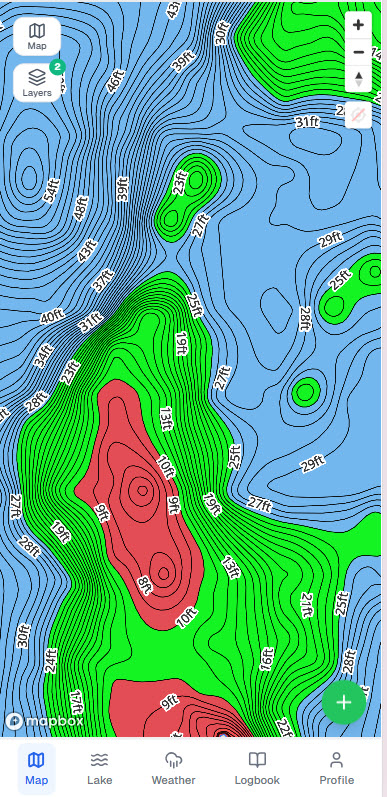
Depth shading makes the edge of a flat easy to see: shallow water shows warm, deep water shows blue, and the first break is where the colors change fastest.
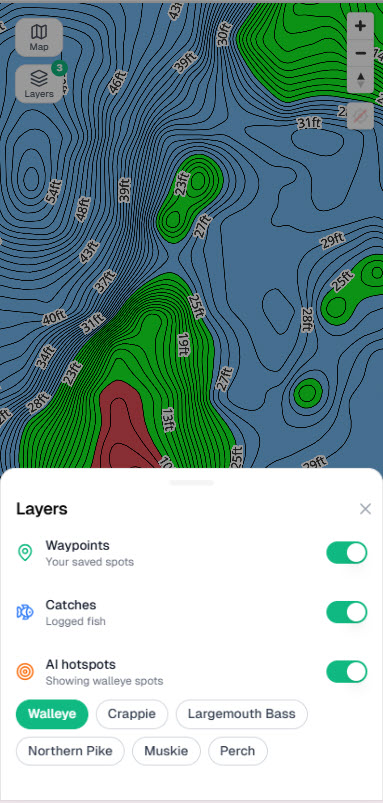
Check Species Hotspots for walleye on the same lake. If a hotspot sits on your break, you've probably found your starting spot.
Find your first-ice bay and drop waypoints in the app →
🕳️ Drill a Line, Not a Spot
The most common first-ice mistake is drilling one hole on a spot that looks good and sitting on it all day. Walleye at first ice are moving, so you need to find the depth they're using that day.
Drill a line of holes from the shallow flat to the first break, about 15–20 yards apart: one at 8 feet, one at 10, one at 12, and so on, down to the bottom of the break. Drill them all at once so you aren't running the auger over fish later.
Fish each hole for 10–15 minutes. Start shallow at low light and deeper in midday. If you mark fish on your flasher but they won't bite, try one more presentation and then move on. If a hole doesn't show fish in 15 minutes, go to the next one.
When you catch one, drill around it. Walleye at first ice travel in loose groups. Once you find the depth they're using, drill a few more holes at that depth along the break.
🎣 What to Jig
Most first-ice walleye anglers fish two lines: an active jigging line to call fish in, and a still line beside it to catch the ones that won't chase. (Check current regulations for how many lines you can run.)
- Jigging spoon with a minnow head. The standard first-ice bait. Snap it up, let it flutter down, and pause. Gold, perch, and glow colors work well in low light.
- Rattle bait. A lipless rattle bait, like a Rapala Rippin' Rap, makes noise that pulls fish in from a distance. Use it to find active fish, then switch to the spoon if they come in and won't bite.
- Deadstick minnow. A live minnow on a small jig or plain hook, set 6 inches to a foot off the bottom in a hole next to your jigging hole. Fish that come in on the spoon often eat the still minnow instead.
- Tip-ups. A big shiner on bottom under a tip-up works all day and covers another spot while you jig.
Jig weight: in 8–15 feet, a 1/16–1/8 oz spoon or jig is usually enough. Go heavier only if you need to get down faster or call fish from a distance. For more on weight by depth, see the Ice section of our walleye jig weight chart.
If fish come in on the flasher and won't commit, slow down: smaller jig, shorter snaps, longer pauses.
🌅 When to Be on the Hole
At first ice, the hour before sunrise to an hour after and the last hour of light into dark are the best times. That's when walleye move up out of the deeper water to feed on the flat. In midday, fish slide down the break or go quiet, so that's a good time to drill new holes, move deeper, or set tip-ups.
On stained lakes like Upper Red and Lake of the Woods, low light lasts longer, so the midday bite can be better than on clear lakes. On cloudy days, fish often feed longer, too.
The Fishing Score Bite Timeline shows these windows hour by hour for your lake, based on solunar timing, pressure, and weather. Use it to plan when to be set up over your best hole, not just which day to go.
🏞️ Lakes Known for a First-Ice Bite
These lakes are known for good first ice. For full DNR survey data and current regulations on each one, follow the links to our 10 Best Walleye Lakes in Minnesota.
Upper Red Lake (Beltrami County, near Waskish) — The shallow basin freezes fast, so Upper Red is often one of the first big lakes in the state with fishable ice, and its first-ice walleye bite is one of the most reliable in Minnesota. Fish spread across the basin, so plan to move until you find them. Remember that the western part of the lake is reservation water and closed to non-band members.
Lake Vermilion (St. Louis County, near Tower) — Bays freeze well before the main basins. Fish move into shallow bays next to deep water in 8–15 feet, and tullibee in the lake keep them feeding. Look for the rock points at the mouths of those bays.
Leech Lake (Cass County, near Walker) — The big bays lock up first. Fish the 8–15 ft edges and the closest bars or humps to the bay. As the main lake freezes, fish move out to the main-lake bars.
Lake of the Woods (Lake of the Woods County, near Baudette) — At first ice, it's the protected bays along the south shore, not the main lake, that are fishable. Ice roads and resort fish houses usually come later, once the ice is thick enough. Rules on the Rainy River and Four-Mile Bay differ from the main lake, so check which water you're on.
📉 When First Ice Is Over
First ice usually lasts two to three weeks. These are the signs it's ending:
- The dawn and dusk bite in the shallows gets shorter and then stops.
- Your flasher shows fewer fish in 8–15 feet, and the fish you catch come from the bottom of the break.
- Snow builds up on the ice and the green weeds die back.
When that happens, walleye move out to main-lake breaks and humps in deeper water and bite more slowly. Our ice guide's Mid-Winter section covers where to go next.
🥶 Safety first: first ice is the least predictable ice of the year. Check it with a spud bar every 150 feet as you walk out. See our ice safety guide and the Minnesota DNR ice safety page before you go.
❓ FAQ
What depth are walleye at first ice? Usually 8–15 feet, in shallow bays and on flats next to deeper water. They come shallower at dawn and dusk and drop toward the bottom of the first break during the day.
What's the best bait for first-ice walleye? A jigging spoon tipped with a minnow head, fished next to a deadstick with a live minnow 6 inches to a foot off the bottom. A lipless rattle bait helps call fish in, and tip-ups with large shiners work all day.
How long does the first-ice bite last? Usually two to three weeks after safe ice forms. It ends as snow builds, weeds die off, and walleye move to deeper main-lake structure.
What time of day is best for first-ice walleye? Dawn and dusk. The hour around sunrise and the last hour of light into dark are best, when walleye move shallow to feed. On stained lakes and cloudy days, the bite can last longer.
Every moment on the water is too good to waste drilling holes in the wrong bay. Try Fish Guide Pro free and mark your first-ice spots on 1-ft contours before you ever leave the house.