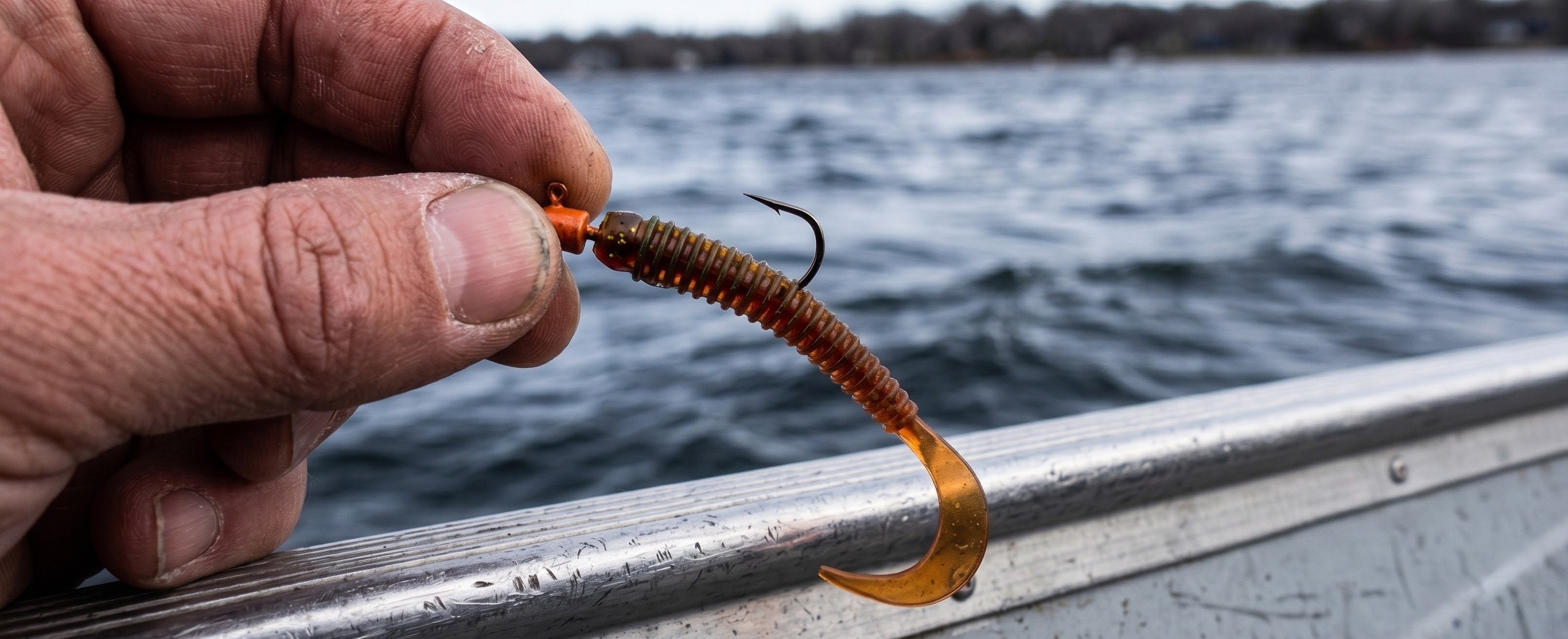
"What size jig should I use?" doesn't have one answer — it has four. Depth gets you in the right range, wind and current knock you up or down a size from there, whether you're jigging vertically or casting/swimming a bait changes the baseline entirely, and your line type shifts the math again. Most walleye jig weight charts online give you one column and call it done. This one doesn't, because a 3/16 oz jig that's perfect vertical jigging in 12 ft of water is overkill for casting a paddle tail across that same flat.
Jump to a section:
- 📏 Vertical Jigging — Weight by Depth
- 🎯 Casting & Swimbait Jigging — Weight by Depth
- ❄️ Ice Fishing Jig Weight
- 💨 Adjusting for Wind and Current
- 🧵 Line Type Changes the Math
- 🪨 Tungsten vs. Lead: When the Upgrade Is Worth It
- 📡 Forward-Facing Sonar Has Changed the Math
- 🎣 Quick Reference by Situation
- ❓ FAQ
📏 Vertical Jigging — Weight by Depth
This is the classic straight-up-and-down presentation — dropping a jig below the boat and working it vertically over structure or suspended fish. Depth is the primary driver here because gravity, not a retrieve, is doing most of the work getting your bait down and keeping it in bottom contact.
| Depth | Jig Weight | Notes |
|---|---|---|
| 0–8 ft | 1/16–1/8 oz | Shallow, calm — go as light as you can keep contact with bottom |
| 8–15 ft | 1/8–3/16 oz | The all-around standard range for most summer vertical jigging |
| 15–20 ft | 1/4–3/8 oz | Where most anglers start under-gunning it — don't be afraid to size up |
| 20–30 ft | 3/8–1/2 oz | You need to feel bottom, not guess at it |
| 30 ft+ | 1/2–3/4 oz | Deep structure and suspended fish over deep water |
The test at every depth is the same: can you still feel bottom and detect a bite without your line bowing out? If you're not feeling bottom cleanly, go up a size before you change anything else.
🎯 Casting & Swimbait Jigging — Weight by Depth
Casting and swimming a jig — snapping a paddle tail across a flat, pitching to fish marked on sonar, working a shoreline — runs a different calculus than vertical jigging. The retrieve itself keeps the bait moving and in the zone, so you typically fish lighter than the vertical chart at the same depth. Go too heavy here and you'll drag bottom, snag weeds, or blow past fish too fast.
| Depth | Jig Weight | Notes |
|---|---|---|
| 0–8 ft (sand/gravel flats, shoreline) | 1/16–1/8 oz | Standard opener-week pitching weight for shallow sand and gravel |
| 8–15 ft | 1/8–1/4 oz | Bump toward 1/4 oz around current, weeds, or deeper breaks |
| 15 ft+ | 1/4–3/8 oz | Casting gets less common this deep — most anglers switch to vertical instead |
Casting distance is its own factor separate from depth: fishing from shore, casting into the wind, or needing extra range to reach a break line can all call for sizing up even in shallow water, simply to get the bait where it needs to go.
❄️ Ice Fishing Jig Weight
Ice fishing flips a couple of the open-water rules — there's no wind pushing your line around, but presentation is still vertical, so depth stays the main driver. First-ice fish move into shallow bays adjacent to deep water, typically 8–15 ft, chasing cisco and perch — tip-ups with large shiners fished on bottom and small jigging spoons tipped with a minnow head (working around 1/16–1/8 oz in that depth range) are the standard first-ice approach, with spoons getting the nod during low-light windows. As winter progresses and fish push out to deeper main-lake basins along the contour, weight typically climbs toward 1/4–3/8 oz or heavier to reach and hold in that depth.
💨 Adjusting for Wind and Current
Wind and pressure change the day as much as the jig does. The fishing score grades both before you go.
Wind and current both do the same thing to a jig: push it out of the strike zone before it reaches bottom, or drag it around once it's there. Before you reach for a heavier jig, boat control is worth trying first — spot-locking or dropping a drift sock slows your drift and can solve the problem without changing your bait's action or fall rate at all. Once boat control alone isn't enough, size up rather than down; a lot of anglers instinctively go lighter when the bite gets tough, but in real wind or current that usually means you're not even in the strike zone anymore.
| Condition | Adjustment |
|---|---|
| Glass calm | Use the base chart as-is, or go one size lighter for extra finesse |
| Light chop / breeze | Base chart weight |
| Moderate wind (whitecaps forming) | Try boat control first; if that's not enough, bump up one size |
| Heavy wind | Bump up two sizes, or switch to tungsten to add weight without adding bulk |
| River current — slow to moderate | Base chart weight, moving toward the heavier end of the depth range |
| River current — heavy | 3/8 oz to 1 oz — depth and current combine to push you toward the top of that range |
River jigging in particular runs on both current speed and depth together — if your jig is sweeping downstream before it hits bottom, that's your sign to go heavier, not to change technique.
🧵 Line Type Changes the Math
The same jig weight feels different depending on what's above it. Braid has essentially no stretch, so you feel bottom contact and bites more directly — that's why anglers casting light jigs upwind lean on high-strand braid with a fluorocarbon leader, since it lets them stay lighter than mono would allow at the same depth. Straight monofilament stretches, which softens bite detection and bottom feel, so if you're running mono instead of braid-to-fluoro, size up slightly from either chart to compensate for the lost sensitivity.
🪨 Tungsten vs. Lead: When the Upgrade Is Worth It
Tungsten is denser than lead, so a tungsten jig holds the same weight in a noticeably smaller package — which means you can go heavier to fight wind or current without the bulkier profile spooking fish or looking unnatural. That combination of smaller size and more sensitivity is exactly why tungsten gets reached for on windy days and in current: anglers can increase weight without increasing size, which keeps bites coming even when a lead jig of the same weight would be too bulky. Tungsten also transmits bottom feel more sharply through the line, and many anglers running forward-facing sonar report it shows up more distinctly on-screen than lead does, though that's angler experience rather than something measured.
It's not mandatory — lead jigs catch plenty of walleye — but if you're fishing wind, current, or forward-facing sonar regularly, tungsten is the upgrade that actually changes how many fish you detect and hook, not just a nice-to-have.
Looking for something lighter than 1/16 oz for finesse presentations in calm, clear water? That's ned rig and drop shot territory — see our Drop Shot & Ned Rig for Walleye guide for that end of the spectrum.
📡 Forward-Facing Sonar Has Changed the Math
If you're fishing with Livescope or another forward-facing sonar unit, the old rule of "fish bottom, feel for the tap" doesn't fully apply anymore. A lot of anglers now fish lighter than they used to and float a jig above a fish they've actually marked on-screen, rather than dragging bottom and hoping something's down there. Instead of sizing a jig purely to reach depth fast, you're sizing it to fall slowly and naturally past a specific fish while you watch it react in real time — which often means going a size lighter than this chart's depth range would otherwise suggest, especially when casting past a marked fish and swimming the jig back through its zone. If you've got electronics that let you see individual fish, let that override the depth chart before wind or current do.
🎣 Quick Reference by Situation
| Situation | Style | Weight | Line |
|---|---|---|---|
| Calm morning, 10 ft, jig-and-minnow | Vertical | 1/8 oz | Braid + fluoro leader |
| Windy afternoon, 12 ft | Vertical | 3/16–1/4 oz, tungsten preferred | Braid + fluoro leader |
| Vertical jigging, 25 ft, calm | Vertical | 3/8 oz | Braid, tied direct or short leader |
| Pitching shallow sand/gravel, opener week | Casting | 1/16–1/8 oz | Braid + fluoro leader |
| Pitching current, weeds, or deeper water | Casting | 1/4 oz | Braid + fluoro leader |
| Snapping a paddle tail across a flat, 8–15 ft | Casting/swimming | 1/8–1/4 oz | Braid + fluoro leader |
| Spring river current, moderate | Vertical/drift | 3/8–1/2 oz | 6 lb mono or braid-to-fluoro |
| Heavy river current | Vertical/drift | 3/4–1 oz | Braid-to-fluoro for feel |
| Casting light jigs upwind, clear water | Casting | 1/16–1/8 oz tungsten | Braid + 4–6 ft fluoro leader |
| First-ice, shallow bay, 8–15 ft | Vertical (ice) | 1/16–1/8 oz | Light mono or braid |
| Mid-winter, deep main-lake basin | Vertical (ice) | 1/4–3/8 oz+ | Light mono or braid |
| Deep suspended fish, 30 ft+ | Vertical | 1/2–3/4 oz | Braid, tied direct |
❓ FAQ
What's the most versatile all-around walleye jig weight? For most Minnesota lake fishing in the 8–15 ft range under normal conditions, 3/16 oz covers the widest range of vertical jigging situations. For casting and swimbait presentations at the same depth, 1/8 oz is the better all-around starting point.
Should I size up or down when the bite is slow? It depends on why it's slow. If fish are just finicky, sizing down to finesse them is reasonable. But if you're not in constant bottom contact — because of wind, current, or depth — sizing up to actually reach and stay in the strike zone will usually out-produce going lighter.
Do I need tungsten, or is lead good enough? Lead works fine for calm, moderate-depth fishing. Tungsten earns its cost back in wind, current, and anywhere you're using forward-facing sonar, since the smaller profile and sharper feel make a real difference in exactly those conditions.
Is ice fishing jig weight different from open water? Depth still drives the decision, but there's no wind to fight under the ice, so weight tracks depth more directly than it does in open water. First-ice fish in shallow bays call for light jigs and spoons; as fish push to deeper main-lake basins later in winter, weight climbs accordingly.
How do I know my actual depth before I pick a jig? This is where a lot of anglers guess. Pulling up the Contour Map before you start fishing tells you the depth at your exact spot instead of estimating from your electronics after you're already set up wrong.
Every moment on the water is too good to waste re-tying because you started with the wrong weight. Pair this chart with our full Walleye Rod, Reel & Line Setup Guide for the complete jigging setup, or see the Walleye Fishing Cheat Sheet for the full seasonal picture.
Related Reading
- Walleye Fishing Cheat Sheet (Hub) — seasonal patterns, lure colors, live bait, electronics, and more
- Walleye Rod, Reel & Line Setup Guide
- Drop Shot & Ned Rig for Walleye: Finesse Rig Setup Guide
- Walleye Seasonal Patterns: A Season-by-Season Minnesota Depth & Structure Guide