This is your quick-reference hub for Minnesota walleye fishing — bookmark it or save it to your home screen for the boat. Below you'll find quick-reference tables for seasonal patterns, lure color selection, what to do when they won't bite, live bait, electronics, and equipment — plus links to in-depth guides on seasonal depth patterns, live bait and rigging, rod/line/reel setup, finesse rigs (drop shot and ned rig), and trolling (lead core, snap weights, and planer boards).
For more depth on the structure concepts referenced below, see How to Read Depth Contour Maps for Fishing and 10 Best Walleye Lakes in Minnesota.
Jump to a section:
- 📅 Seasonal Patterns & Depth — quick-reference table
- 🎨 Lure Color Selection
- 😤 When They Won't Bite — Finesse · Aggressive · Prime Windows · Barometric Pressure
- 🐟 Live Bait — bait-by-season table
- 🎛️ Electronics & Reading Structure
- 🎛️ Equipment & Rigging Guides — Quick Reference table
- 🐠 Catch, Handle & Release
- 📍 Using Fish Guide Pro for Walleye
Full in-depth guides:
- 📅 Walleye Seasonal Patterns: Spring, Summer, Fall & Winter Depth Guide
- 🐟 Live Bait for Walleye: Minnows, Leeches, Crawlers & Slip Bobber Rigging
- 🎣 Walleye Rod, Reel & Line Setup Guide
- ⚖️ Walleye Jig Weight Chart: Depth, Wind & Current Guide
- 🪱 Drop Shot & Ned Rig for Walleye
- 🚤 Trolling for Walleye: Lead Core, Snap Weights & Planer Boards
📅 Seasonal Patterns & Depth
Walleye location follows water temperature and forage in predictable seasonal patterns — here's where to start looking, at a glance. Every pattern below includes specific techniques, top lures, and rigging tips in the full guide.
| Pattern | Water Temp | Depth | Key Structure |
|---|---|---|---|
| 🌱 Pre-Spawn | 38–44°F | 8–15 ft | Main-lake points, rocky shorelines, first major break |
| 🌱 Spawn Run | 42–50°F | Shallow current | River tributaries, current breaks, eddies behind boulders |
| 🌱 Post-Spawn | 50–58°F | 4–8 ft | Shallow rock flats, south-facing shores, inside turns |
| ☀️ Early Summer | 58–68°F | 10–20 ft | Weed edges, mid-depth rock, submerged points |
| ☀️ Mid-Summer Suspended | 70–80°F | 18–28 ft | Mid-lake humps, sunken islands, thermocline break |
| ☀️ Night Bite | Any | 3–8 ft | Rocky shoreline, inside turns on points — after dark |
| 🍂 Early Fall Frenzy | 50–58°F | 5–15 ft | Wind-blown rocky points and reefs |
| 🍂 Late Fall Deep Structure | 40–50°F | 20–30 ft | Main-lake humps, mid-lake bars, deep weed edges |
| ❄️ First Ice | 32–36°F | 8–15 ft | Shallow bays adjacent to deep water |
| ❄️ Mid-Winter | 33–37°F | 22–35 ft | Main-lake breakline, soft-to-hard bottom transition |
Read the full guide: Walleye Seasonal Patterns: A Season-by-Season Minnesota Depth & Structure Guide — covers structure, techniques, top lures, and rigging tips for all 10 patterns above, from pre-spawn points to mid-winter breaklines.
🎨 Lure Color Selection
The real rule: Color is important, but it's about the 10th most important factor. Location, depth, presentation speed, and bait profile matter more. Once those are dialed in, use color to fine-tune.
How to Think About Color
Break color down into four categories and adjust based on conditions:
Shiny (Chrome, Silver, Gold): Best in clear water with good light. Chrome reflects maximum light and calls fish from a distance on sunny days. Gold is the all-purpose choice — it works in almost any condition and mimics perch well.
Natural/Translucent (Ghost, Smoke, Pearl, Natural Perch): Best in clear, calm, high-pressure conditions when fish are spooky. Translucent baits look like real baitfish and don't alarm pressured or post-front walleye. If they were biting and suddenly stopped, switch to natural.
Bright/Opaque (Chartreuse, Orange, Yellow): Best in stained or darker water where fish need to find the bait visually. Chartreuse is the single best stained-water walleye color — it cuts through murk better than anything. Orange and gold work well in low-light and fall conditions.
Dark Profiles (Black, Purple): Best at night and on very dark overcast days. A dark bait creates a strong silhouette against the surface that walleye can see from below. Purple is especially effective in dark water and at last light.
| Condition | Go-To Colors | Why It Works |
|---|---|---|
| Sunny / Clear Water | Chrome, Silver, Ghost, White Pearl | High flash attracts from distance; translucent looks natural up close |
| Cloudy / Stained Water | Chartreuse, Orange/Gold, Yellow Perch | Bright/matte colors cut through stain; chartreuse is the #1 stained-water producer |
| Dirty / Muddy Water | Chartreuse + Orange, Big White Profile, Blade Spinner combos | Go big and bright; fish need to feel and see it — add a blade for vibration |
| Night / Low Light | Black, Dark Purple, Glow White, UV Pink | Dark profiles silhouette against surface; glow for complete darkness |
| Gold — Overcast / Fall / Low Light | Gold, Brass, Gold + Orange Belly | Gold reflects warm tones; best on overcast days, dusk/dawn, and fall perch bite |
| Post-Cold Front / Pressured Fish | Matte Natural, Smoke Gray, Natural Perch | Downsize and go natural; finicky fish want subtle and realistic |
Practical Color Tip
Pay attention to where fish are hooking up. If they're nailing the front hook of a harness, they're keying on the blade color. If they're hitting the trailing hook, they're following the bait — the back color and bead color matter more. Adjust from there rather than guessing.
Walleye are biologically tuned to pick up orange, red, green, and yellow well, but don't see UV light the way some other species do — which is part of why gold, orange, and perch patterns are so consistently productive, especially in low light. UV-enhanced colors like glow and UV pink still work, mostly because they appear brighter at dawn/dusk and under artificial light, not because walleye "see UV" directly. Recent Minnesota fishing reports back this up — on Lake of the Woods in late May 2026, gold mixed with glow white, pink, orange, or chartreuse was producing consistently on jig-and-minnow presentations, right in line with the gold/perch-pattern recommendation above.
😤 When They Won't Bite
Try finesse adjustments first. If that fails, trigger a reaction with aggression. If nothing works — move or wait for a prime window.
Jump to: Go Finesse · Go Aggressive · Prime Windows · Barometric Pressure
🔬 Go Finesse
Best for: Post-front, clear water, pressured fish, cold/slow bite
- Downsize your jig — Drop to 1/16 or 1/8 oz tungsten; smaller profile for picky fish
- Go lighter line — Drop to 6 lb fluorocarbon; lighter line = less visibility and better feel
- Extend pauses — 5–10 second dead-stick pause after every lift; walleye often bite on the pause
- Switch to a slip-bobber rig — Small minnow suspended at fish depth, nearly motionless; hard for a neutral fish to ignore
- Ned rig — Small (2–3") floating soft plastic on a 3/16 oz mushroom-head jig; drag slowly on bottom with tiny rod-tip pops ("the bop") — that kicking tail does all the work. Always let it hit bottom before working it, even over suspended fish. Works in 4 ft or 40 ft. See our Drop Shot & Ned Rig guide for the full setup.
- Drop shot rig — Weight on the bottom, hook 12–18 inches up the line; keeps a shiner or small minnow right at fish level without pulling it away. See our Drop Shot & Ned Rig guide for the full setup.
- Add a stinger hook — If fish are short-striking a larger jig, a stinger grabs the ones that only nip the tail
⚡ Go Aggressive
Best for: Active fish ignoring slow presentations, stained water, windy conditions
- Upsize your bait — Bigger paddle tail (4–5") or swimbait to trigger reaction strikes; in stained water fish need a bigger target to find
- Snap jig aggressively — 2–3 hard pops off bottom, let it flutter down; pure reaction bite
- Add noise and vibration — Attach a blade or rattle to your jig; fish can feel vibration before they see it — critical in dirty water
- Speed up your troll — Sometimes faster speed is the trigger; if fish are following but not committing, try 0.2–0.3 mph faster
- Rip bait — Lipless crankbait or blade bait ripped up and allowed to flutter down; walleye almost always hit on the fall
⏰ Prime Windows — Always Fish These
Walleye are fundamentally light-sensitive predators. Their eyes are built for low light, giving them a massive advantage over prey at dawn, dusk, and after dark. Fish these windows hard even if midday is slow:
- Dawn — First 90 minutes of light
- Dusk / Sunset — Last 2 hours of light; often the best window of the day
- After dark — Especially summer and early fall; walleye move shallowest
- Overcast all day — Flat light lets walleye stay shallow and feed without discomfort
- Solunar major/minor periods — Fish feed on predictable lunar-driven schedules
- Rising barometer after a cold front — Fishing improves 24–48 hrs after the front passes as pressure stabilizes
🌡️ Barometric Pressure & Walleye Behavior
Barometric pressure is one of the most reliable bite predictors, especially on pressured lakes. Here's how to read it:
| Pressure Condition | What Walleye Do | How to Respond |
|---|---|---|
| Steady / Stable | Normal feeding behavior — rely on structure and solunar windows | Fish your standard approach |
| Falling (approaching front) | Often feed aggressively right before a front hits — can trigger a frenzy | Fish fast and cover water; capitalize on the pre-front window |
| Low / After front | Feeding shuts down; fish go deep and suspend | Downsize, slow way down, dead-stick presentations |
| Rising (recovering) | Bite gradually improves over 24–48 hrs | Start finesse, switch to normal as pressure climbs |
Cold Front Rule: A passing cold front is the single biggest bite-killer in walleye fishing. The barometer drops as the front approaches (good fishing), slams low as it passes (terrible), then gradually rises after (improving). Plan your trips on the rising side of a front, not immediately after one passes.
Post-Front Adjustments: After a front, walleye hug the bottom and refuse to chase. They reposition away from their normal feeding zones into tighter comfort areas — subtle depth changes, deeper structure edges, and transition zones. Stop covering water aggressively and instead work slowly through where they've likely settled. Downsize to a 1/16 oz jig, 2" finesse plastic, or a small minnow on a plain hook with a split shot. Work ultra-slow with long pauses and target the deepest edge of structure. Fish mid-day when temperatures peak and pressure starts to stabilize — that's often the only productive window right after a front. Two to three days after the front passes, fish are frequently more aggressive than before it hit — worth planning a return trip around.
🐟 Live Bait
Live bait almost always outperforms artificials when the bite is slow, post-front, or in cold water. The key is matching bait size and type to the season — smaller in cold water, larger for trophy fish.
| Bait | Size | Best For | Seasons | Notes |
|---|---|---|---|---|
| Fathead Minnow | 2–3" | Jig tipping, year-round all-purpose | All seasons | Most versatile. Hook through lips for jigging. Through back for slip bobbers. Durable and widely available. |
| Shiner / Roach | 3–4" | Cold water, trophy fish, tip-ups | Spring, Winter | Top producer at first ice and pre-spawn. Lively in cold water. Hook in front of the dorsal fin for tip-ups. |
| Nightcrawler | Full or half | Spinner rigs, summer trolling | Summer, Fall | Thread full-length onto spinner harness with trailing hook through the tail. Soft plastics (rigging leeches) can substitute when small perch are stealing crawlers — more durable and still catch fish. |
| Leech | Medium to Jumbo | Slip bobber, jig tipping, drop shot, stand-up jigs | Summer (June–Sept) | The #1 summer walleye bait in Minnesota. Hook through the sucker end (wider end) — not the tail, which kills them quickly. Jumbo leeches are the go-to on slip bobbers; medium for jig tipping and drop shots. Completely useless below 55°F — they ball up and won't swim. Transition from minnows to leeches after the first major insect hatch, typically mid-June. |
| Cisco / Tullibee | 4–6" | Trophy ice fishing, first-ice tip-ups | Winter | Premium first-ice bait. Hook through back on large tip-up. Big fish forage — worth the extra cost for trophy-focused trips. |
| Creek Chub | 3–5" | Big fish trolling, river walleye | Spring, Fall | Excellent for trophy-sized walleye. Trolled behind bottom bouncer or spinner. More active swimming action than fatheads. |
Read the full guide: Live Bait for Walleye: Minnows, Leeches, Crawlers & Slip Bobber Rigging — covers hooking technique for every rig, hook sizing, a complete slip bobber setup, and how bait choice shifts from cold water through the mid-June leech transition into summer.
🎛️ Electronics & Reading Structure
Understanding your sonar is what separates consistent anglers from those who "got lucky." You don't need the most expensive unit — you need to understand what you're seeing.
What to Look For
Fish arches (2D sonar): A classic fish arch appears when a fish passes under your transducer while you're moving. The arch forms because the fish enters the outer edge of the sonar cone (shorter distance = higher return), passes through the center (closest point), and exits the far edge. Stationary fish appear as a flat line, not an arch.
Stacked fish: Multiple returns at the same depth indicate a school holding on structure. Mark this location and work it systematically before moving.
Bottom composition: Hard bottoms (gravel, rock) return a bright, sharp, well-defined line with a second echo below it. Soft bottoms (mud, sand) return a softer, thicker line with no second echo. Walleye consistently prefer hard bottom — especially the transition edge between hard and soft.
Thermocline: In summer, many sonar units show a faint hazy layer in the water column. This is the thermocline. Fish the edge just above this layer in warm months.
Electronics-First Approach
Before dropping a jig, use your sonar and/or side imaging to confirm fish are on the spot. It seems obvious, but most beginners spend 2–3 hours on a hump that has no fish. Drive around at speed, scan for fish arches, then stop and fish what you find. Moving until you find fish is more productive than hoping they're where you think they should be.
🎛️ Equipment & Rigging Guides
The right rod, line, and reel — plus the right rig for fish that won't chase — make the biggest difference in how many walleye end up in the boat. Quick reference below, then dig into the full guides for each.
⚡ Quick Reference — Setup by Situation
| Situation | Rod | Line | Reel |
|---|---|---|---|
| Pitching jigs, spring/fall | 7'2" ML Fast | 10 lb braid + 8 lb fluoro leader | 2500 spinning |
| Finesse / clear water | 7'0" ML Fast | 6–8 lb fluoro straight | 2000–2500 spinning |
| Stained water / current / river | 6'10" M XF | 8–10 lb braid direct (or short fluoro leader) | 2500–3000 spinning |
| Bottom bouncers / spinners (rocky bottom) | 7'0" M XF | 10–14 lb mono or braid | Low-profile baitcast w/ line counter |
| Bottom bouncers / spinners (clean bottom) | 7'0" M Moderate | 10–14 lb mono or braid | Low-profile baitcast w/ line counter |
| Summer trolling crankbaits (shallow) | 7'6" M Moderate | 10–14 lb mono | Low-profile baitcast w/ line counter |
| Lead core trolling (suspended fish) | 8'–8'6" M Moderate | 18–27 lb lead core + 15–25 ft fluoro leader | Low-profile baitcast w/ line counter |
| Ice jigging (tungsten) | 28–32" L Fast | 4–5 lb fluoro | Small ice reel |
| Ice finesse / dead bite | 28" L Fast | 3 lb fluoro | Small ice reel |
Read the full guides:
- Walleye Rod, Reel & Line Setup Guide — rod setups by technique, full line breakdown (braid, fluorocarbon, mono, lead core, ice line), reel sizing, and the three essential knots
- Walleye Jig Weight Chart — the right jig weight by depth, wind, current, and line type, for both vertical jigging and casting
- Drop Shot & Ned Rig for Walleye — finesse rigs for fish that won't chase: complete drop shot setup and the ned rig "bop" technique
- Trolling for Walleye: Lead Core, Snap Weights & Planer Boards — depth control and line-spreading for suspended mid-summer walleye
🐠 Catch, Handle & Release
Proper handling keeps walleye healthy — important for the fishery, and legally required if you're releasing a fish under size or over a slot limit.
Hook Sets — Don't Blow It
How you set the hook matters as much as how you present the bait:
Jigging: When you feel a tick or the line goes heavy, sweep the rod firmly to the side — not a straight-up spike that breaks light line. With braid, you don't need to drill it; a solid pop and keep reeling. Over-setting with braid will pull the hook or break the line. With fluoro or mono, a more deliberate set is fine.
Bottom bouncers / rod holders: When a rod doubles over in the holder, grab it smoothly and lift in one motion — don't yank hard. A firm pop to seat the hook, then keep the rod tip up and reel. Slack is death; never drop the rod back down.
Drop shot / live bait rigs: Don't slam it. Drop the rod tip slightly when you feel the bite to confirm the fish is munching, then reel into them — a "reeling hook set." Setting too hard on a fine-wire drop shot hook straightens it. Let the hook do the work.
Slip bobber: When the bobber goes under or lays flat, reel down to the fish first to remove slack, then make a smooth sweeping set. The longer, soft rod does most of the work without ripping the hook out on a small #2 or #4.
Fish Handling
Keep it in the water: A walleye out of water is suffocating — every second matters. If you're releasing, minimize air time. The fish went through a fight; it needs water to recover.
Hold it right: Support the body horizontally with two hands for any fish over 16". Never hold a walleye vertically by the jaw for more than a couple seconds — it stresses the spine and internal organs. Quick photo, then back in.
Lipping: Walleye have small sharp teeth — grip the lower jaw firmly with your thumb inside the mouth and fingers under the chin. Wet your hands first; dry hands strip the protective slime coat that defends against infection and fungus.
Reviving a fish: If a walleye rolls on its side after release, don't just drop it in. Hold it upright facing into any current (or move it gently forward and back) until it kicks away on its own power.
Hook removal: Use needle-nose pliers for any hook you can't easily reach. If a fish is deeply hooked in the gills or gut, cut the line close to the hook and release — the fish survives a hook better than a torn-up gill arch.
Summer heat: When water exceeds 75°F, walleye stress and post-release mortality rise sharply. Keep fights short, get the hook out fast, and lower the fish in gently. Consider keeping fish in a livewell if you plan to eat them rather than doing a long revival in warm water.
📍 Using Fish Guide Pro for Walleye
Every pattern on this page starts with the same question: where's the right depth and structure for right now? Fish Guide Pro is built to answer that in minutes.
Species Hotspots — Fish Guide Pro scores structure for walleye automatically by season. A post-spawn drop-off zone, for example, might score 81/100 with a "Priority 5/5" rating for a steep break in 4–19 ft of water with a target depth around 10–11 ft — exactly the kind of inside turn described in the Post-Spawn and Early Summer patterns. Every zone comes with the reasoning behind the score, so you know why a spot is marked before you run to it.
1-ft Depth Contours + Depth Shading — Every structure type covered in our Seasonal Patterns guide — points, saddles, humps, breaklines, weed edges — shows up clearly on Fish Guide Pro's 1-ft contour maps with color-coded depth shading. Find the 18–25 ft thermocline break for Mid-Summer Suspended walleye, or the 22–35 ft main-lake breakline for Mid-Winter, before you ever leave the dock. Pair the map with your electronics — know what's down there before your sonar confirms it.
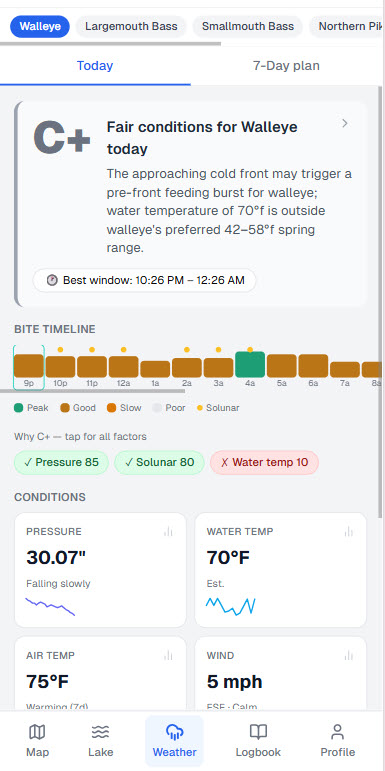
Weather & Bite Forecast — The When They Won't Bite section leans heavily on pressure trends and solunar timing. Fish Guide Pro's weather panel rates each day's walleye bite potential, shows an hour-by-hour bite timeline, and flags pre-frontal feeding windows — so you know whether a falling-pressure window is worth staying out for, or whether to plan around the post-front adjustments instead.
Lake Info & DNR Survey Data — Cisco/tullibee forage presence is one of the strongest predictors of trophy walleye in a lake, and ties directly into our Live Bait guide and the First Ice pattern. It's surfaced right alongside special regulations (protected slots, bag limits) and DNR CPUE data for every Minnesota lake — the context that turns "good structure" into "the right lake."
Trophy Lake Search — Filter Minnesota lakes by species and minimum size to match your goals — harvest, catch-and-release trophy hunting, or both — before you ever load the boat.
Related Reading
- Walleye Seasonal Patterns: A Season-by-Season Minnesota Depth & Structure Guide
- Live Bait for Walleye: Minnows, Leeches, Crawlers & Slip Bobber Rigging
- Walleye Rod, Reel & Line Setup Guide
- Walleye Jig Weight Chart: Depth, Wind & Current Guide
- Drop Shot & Ned Rig for Walleye: Finesse Rig Setup Guide
- Trolling for Walleye: Lead Core, Snap Weights & Planer Boards
- 10 Best Walleye Lakes in Minnesota (2026 DNR Data)
- How to Read Depth Contour Maps for Fishing (Complete Guide)