When walleye are holding tight to the bottom and refusing jigs, crankbaits, and everything else, these two finesse rigs close the deal. The drop shot suspends bait at a fixed height right at fish level; the ned rig drags a small floating plastic across the bottom with a subtle kicking action. Both shine in the same conditions — post-front, clear water, pressured fish — and belong in every walleye angler's toolbox.
This guide is part of our Walleye Fishing Cheat Sheet — head there for seasonal patterns, live bait, electronics, and gear setups.
Jump to a section:
- 🎣 Drop Shot for Walleye — Setup · Technique · When to Use It
- 🪱 Ned Rig for Walleye — Setup · The Bop · When to Reach for It · What It Won't Do
🎣 Drop Shot for Walleye
The drop shot is the precision tool for walleye that won't chase. It holds live bait or a soft plastic at a fixed, exact height off the bottom — you control it by adjusting how far up the line you tie the hook. While a jig sits on the bottom and a ned rig drags across it, a drop shot keeps your bait hovering right at fish level without moving away. Fish sitting tight to bottom, refusing everything else, will often bite a drop shot simply because it won't leave their face.
The Setup
Weight: Tungsten drop shot weight in a thin pencil or teardrop profile, 3/16–3/8 oz. Tungsten is denser than lead — smaller physical size for the same weight, which creates less resistance and a cleaner presentation. Clip it to the very bottom of your line using the weight's built-in snap or a simple loop — tie this connection intentionally weak so the weight breaks off in a snag without losing your whole rig.
Hook: Hook choice varies by bait:
- Nightcrawler / plastic: #1 finesse worm hook (light wire, wide gap)
- Leech or small minnow: #2 octopus or drop shot hook
- Shiner (trophy fishing): #1 straight-shank worm hook, double-hooked through the lips
Tie the hook 8–18 inches up the line from the weight using a Palomar knot. Leave a long tag end after the knot — thread it back through the eye from the front to kick the hook out at 90°, so it stands perpendicular to the line and presents the bait horizontally rather than dangling down.
Distance from weight to hook: 12–18 inches is standard. When fish are holding 1–2 feet off the bottom (common mid-summer), go 18–24 inches. In cold water when fish are tight to the bottom, shorten to 8–12 inches.
Bait: A medium leech hooked through the sucker end is one of the best drop shot baits in summer — it hangs suspended, writhing constantly without going anywhere, which drives neutral fish crazy. Small shiner double-hooked through the lips, half a nightcrawler, a small sucker minnow or redtail chub (especially effective in fall), or a 3–3.5" soft plastic all work well. The drop shot excels with live bait because the weight anchors everything while the bait swims naturally in place. See our Live Bait guide for hooking technique and seasonal bait selection.
Line: 6 lb braid main line to an 8 lb fluorocarbon leader. The thin braid diameter lets the bait sink fast and gives maximum sensitivity. Fluorocarbon stays invisible at the terminal end.
Rod: 7'–7'2" fast action (not extra fast) medium-light spinning rod. Fast — not extra fast — is the call here: extra fast loses the sweeping action you need for a clean hook set, and gives less casting accuracy on light weights. A 2000 or 2500 spinning reel balances the light setup well. See our Rod, Reel & Line Setup Guide for the full rod lineup.
The Technique
Lower the rig to the bottom, then lift just enough to feel the weight tap — fish with the weight on bottom and the bait suspended above. The bait does the work; your job is to keep the weight stationary or move it very slowly.
Subtle shakes: Hold the rod with a slight bow in the line and vibrate your fingers — the weight stays on bottom while the bait shimmies in place. This is deadly on fish you can see on electronics that aren't committing.
Reeling hook set: Don't snap-set on a drop shot — you'll straighten the fine-wire hook or tear the bait off. Drop the rod tip slightly to confirm the fish has the bait, then reel tight and make a smooth upward sweep. The sharp fine-wire hook barely needs pressure to penetrate.
Dead-stick: In the toughest conditions, set the rod in a holder and let wave action or current do the work. A live shiner on a drop shot in a rod holder catches fish that refuse any active presentation.
When to Use It
- Fish you can mark on electronics but can't get to commit
- Post-cold front, high pressure, clear calm water
- Mid-summer deep fish (25–40 ft) holding tight to a specific depth
- River walleye in slow current seams — weight stays put, bait swims naturally
- Fall transition — switch from plastics to small sucker minnows or redtail chubs as water cools
🪱 Ned Rig for Walleye
The ned rig is one of the most underused walleye tools in Minnesota — most anglers think of it as a bass technique. It's a small floating soft plastic on a light mushroom-head jig, dragged slowly on the bottom. In clear water, post-front conditions, or anywhere finicky fish are refusing a regular jig, it consistently produces when nothing else will.
Jump to: The Setup · The Bop · When to Reach for It · What It Won't Do
The Setup
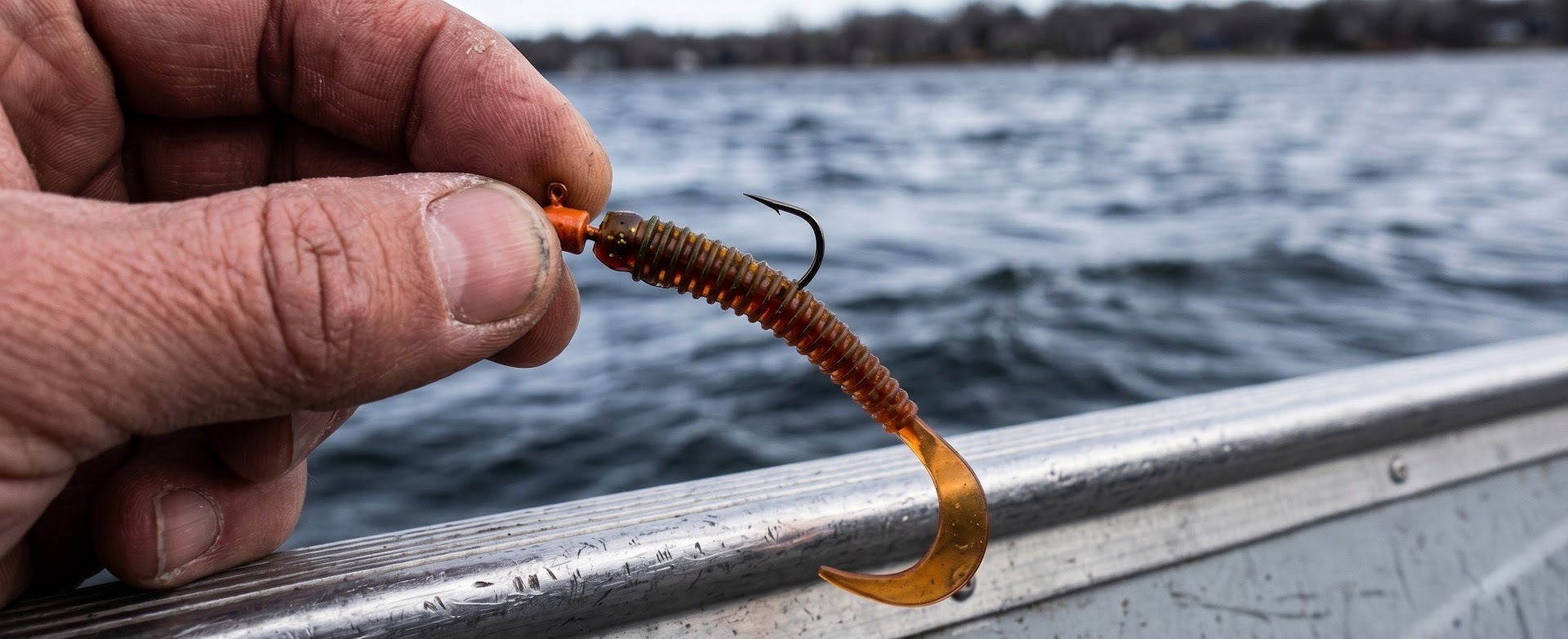
Plastic: 2–3" floating soft plastic in a stick or creature profile. The floating material (TPE) is key — even while the jig head is on the bottom, the tail kicks up and waves. This action is what triggers neutral walleye. Natural colors (goby, perch, smoke) work well in clear water; chartreuse or green pumpkin in stained.
Rigging tip: Score or scuff the plastic where the hook point exits before pushing it through — gives you a clean exit point. Add a small drop of super glue before pushing the plastic all the way up to the jig collar. A properly glued ned rig plastic will last 50–100 fish before needing replacement.
Jig head: Use a jig head specifically designed for ned rigs — not a standard ball head. A purpose-built ned head has a 90° line tie (so the plastic stands up off the bottom rather than laying flat), a wide-gap thin-wire hook for solid hooksets on light rods, and a conical keeper that holds TPE plastic without tearing it. The 90° line tie is the most important part — it's what makes the bait kick up and breathe on the bottom.
| Jig Weight | When to Use |
|---|---|
| 1/8 oz | Very shallow (4–7 ft), calm conditions, ultra-finesse |
| 3/16 oz | All-around go-to — works from 6 to 20 ft in most conditions |
| 1/4 oz | Deeper water (15–25 ft), wind, or when you need to feel the bottom better |
Line: 10 lb braid main line with an 8–10 lb fluorocarbon leader. Braid gives you sensitivity to feel the subtle tick of a walleye picking up the bait; fluorocarbon keeps the leader invisible in clear water. Retie your leader often — dragging a ned rig over rock, zebra mussels, and gravel frays the leader quickly.
Rod: 7'3" medium-light fast action spinning rod. Fast enough to detect bites and set the hook; medium-light tip loads up on the cast so you can throw a light jig accurately.
The Technique — The Bop
Ned rigs were originally designed to be fished suspended in the water column. For walleye, forget that. Always let the bait hit the bottom first — every single cast, regardless of depth or where you're marking fish. Walleye suspended in the middle of the water column will chase the falling bait all the way to the bottom and eat it there.
The bop: Once on bottom, barely move the rod tip — tiny 2–4 inch pops, rod held around 10 o'clock. The goal is to keep the bait bottom-tight while that floating tail kicks and dances. Slowly drag it forward, letting the head skip and the tail breathe. You're not ripping it off the bottom; you're barely disturbing it. This subtle motion accounts for the vast majority of walleye caught on a ned rig.
Detecting bites: A walleye bite on a ned rig often feels like the bait just stops moving or goes slightly heavy — the fish is sitting on it. Any time your bop feels different or the line does something unexpected, set the hook. With a medium-light rod and braid, you have plenty of sensitivity. Don't slam the hookset — a smooth sweep to the side is enough on the thin-wire hook.
When to Reach for the Ned Rig
- Post-cold front — fish are hugging the bottom and won't chase
- Clear water, calm conditions, pressured lakes
- Midday summer when fish are lethargic
- When you can see fish on electronics but they won't touch a jig
- Any rocky or hard-bottom area — the ned rig walks right over snags that a standard jig would hang on
- Weed edge fishing — the standing plastic clears weeds rather than plowing through them
What It Won't Do
The ned rig is not a search bait. It's slow, covers limited water, and works best once you've found fish with electronics or a more mobile presentation. Use a paddle tail or crankbait to locate fish, then switch to the ned rig to pick apart the zone once you know they're there.
Related Reading
- Walleye Fishing Cheat Sheet (Hub) — seasonal patterns, lure colors, electronics, and more
- Walleye Jig Weight Chart: Depth, Wind & Current Guide
- Live Bait for Walleye: Minnows, Leeches, Crawlers & Slip Bobber Rigging
- Walleye Rod, Reel & Line Setup Guide
- Walleye Seasonal Patterns: A Season-by-Season Depth & Structure Guide