Yellow perch are in almost every lake in Minnesota. Big perch are not. In a lot of lakes, perch are so plentiful they stay small, and a 7-inch fish is the best you'll do all day. But on the right lake, at the right time of winter, schools of 10 to 12-inch "jumbo" perch roam the mud flats, and a good school can fill a bucket fast.
This guide covers how to pick a lake that actually grows big perch, where perch move through the ice season, how to find a school on a depth map, the rigs and baits that catch them, and four Minnesota options backed by DNR survey data.
Jump to:
Check any lake's DNR perch survey and find its mud flats on 1-ft contours.
Look Up Any Lake FreeHow to Pick a Minnesota Lake That Grows Jumbo Perch
The biggest factor in catching jumbo perch is choosing the right lake. The Minnesota DNR notes that perch are often stunted from too little food, and that the big ones come mostly from large, hard-water walleye lakes. Perch numbers also swing year to year: one year class can be huge while the next is nearly missing.
That makes a DNR fish survey the best tool you have. When you look up a lake, check three things:
- Size structure. What share of the perch sampled were over 9 or 10 inches? That tells you more than total numbers.
- Year classes. A strong year class that's now 3 to 5 years old is often just reaching keeper size.
- Survey age. Big lakes in the DNR's Large Lake Program are sampled every year. Smaller lakes may go five years or more between surveys.
In Fish Guide Pro, every surveyed lake shows perch catch rates and size charts from the DNR survey data, and Lake Finder lets you search by species and minimum size.
Where Perch Go Under the Ice
| Ice stage | Where to look | Notes |
|---|---|---|
| First ice | Weed edges, sand-to-weed transitions, and the first break near weeds | Perch often mix in with walleye on the first break |
| Midwinter | Mud flats and soft-bottom basins, especially near humps or bars with rock or weeds on top | Schools are largest now; depth varies by lake, from about 12 to 50 ft |
| Late ice | Shallow flats, weedy bays, and inlets near spawning areas | Some of the best perch fishing of the year |
First ice: Perch start the winter near the same weed edges and transitions they used in fall. Look for the first break off a weedy flat.
Midwinter: As the weeds die back under snow and ice, perch move to the soft-bottom flats and basins. They feed on bloodworms and mayfly larvae that live in the mud, rooting through the bottom for them. This is when perch gather into their largest schools of the winter. The best spots are often mud flats right next to a harder feature, like a rock bar or a hump with weeds on top.
Late ice: As the days lengthen, perch move back toward shallow flats and weedy bays near where they'll spawn. The bite can be excellent in the last weeks of safe ice. Ice also gets unreliable near inlets and shorelines late in the season, so check thickness carefully.
Time of day: Perch need light to see and feed, so midday is often the best perch bite, especially in midwinter under thick ice and snow. That's the opposite of walleye, which makes perch a good way to fill the middle of a walleye day.
How to Find a Perch School on a Depth Map
Midwinter perch flats can cover hundreds of acres, and the schools move constantly. You won't find them by sitting in one hole. Use the map to narrow the search, then cover water.
- Find the soft-bottom flats. On a contour map, flats show as wide spacing between lines. In midwinter, focus on the deeper flats and the basin edges, toward the main body of the lake.
- Find the edge of something harder. Look for where a flat meets a hump, a bar, or a point. Mud right next to harder structure tends to hold more perch than open mud in the middle of nowhere.
- Drill a grid or a long line. Cover the flat with holes before you fish. Perch are roaming, so you're trying to intercept a school, not wait for one.
- Check each hole with a flasher. Perch usually hold near the bottom. If nothing shows in a few minutes, move to the next hole.
- Mark the school. When you find fish, drop a waypoint. If they move off, drill toward them along the same depth.
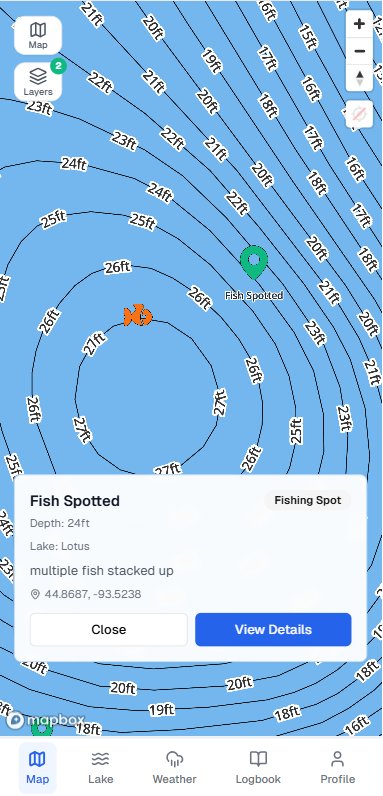
In Fish Guide Pro, set depth shading to the depth band of the flat you're targeting so the flat and its edges stand out. For more on drilling patterns, see how to use a lake depth map for ice fishing.
Best Perch Rigs and Baits for Ice Fishing
| Perch mood | Presentation | Tip with | Line |
|---|---|---|---|
| Active school, first ice or midwinter | Small jigging spoon, 1/32 to 1/8 oz (firetiger, natural perch, or glow) | Minnow head, waxworm, or maggots on the treble | 2 to 4 lb |
| Feeding in the mud (midwinter) | Small tungsten jig with a bloodworm-style plastic | Red or white maggots | 2 to 3 lb fluorocarbon |
| Neutral fish, second line | Drop-shot deadstick: 1/4 oz sinker on bottom, hook 1 to 2 ft above | Live fathead minnow | 4 lb |
Pound the bottom. When perch are feeding in the mud, drop your spoon or jig to the bottom and tap it a few times to kick up a puff of silt, then lift about a foot and hold. The silt cloud looks like feeding activity and draws perch in.
Use light, thin line. Over open basins, thin fluorocarbon sinks faster and is harder for perch to see than heavy mono.
Run a deadstick. Minnesota allows two lines per angler through the ice (one on designated stream trout lakes). A drop-shot rig with a live minnow on a rod in a holder keeps a bait at a fixed depth near bottom while you jig the other hole. When the rod tip loads, pick it up and reel; the perch has often hooked itself.
Bring options. Perch can go from aggressive to finicky with a cold front. Carry spoons for active fish and small tungsten and plastics for slow days.
Minnesota Lakes for Jumbo Perch
Each option below is backed by a recent DNR survey or the DNR's 2026 area fishing outlook. Perch populations shift fast, so check the latest survey in the app before you go.
Upper Red Lake (Beltrami County)
Best for: big perch while you're there for walleye.
The DNR's 2025 survey on Upper Red found 7.4 perch per gill net, and 59% of them were over 9 inches. The DNR describes perch growth here as excellent, with good numbers of 10 to 11-inch fish. Many perch caught while walleye fishing will be big enough to keep. Upper Red is also one of Minnesota's best-known early-ice walleye lakes, so it's an easy two-species trip. State-licensed anglers must stay on state waters on the east side of the lake.
Look up Upper Red's perch survey in the app →
Mille Lacs Lake (Mille Lacs, Aitkin, and Crow Wing counties)
Best for: a deep, offshore jumbo perch bite.
Mille Lacs' DNR survey work shows strong perch year classes from 2018 through 2023, with especially good numbers of 9 to 12-inch fish from the 2021 year class. In the winter of 2025, anglers with good ice conditions reached the deeper offshore areas and harvested more perch than in any winter since 2011. The DNR says the 2025–26 winter was even better, and state perch harvest in each of the last two years has been more than double what it was in earlier years. The DNR expects the 2022 and 2023 year classes to keep growing into keeper size.
Mille Lacs has its own perch limit, which the DNR has adjusted to keep harvest within the state's quota: 5 perch per day through Nov. 30, 2026. Check the DNR's Mille Lacs page for the limit in effect when you fish.
Find Mille Lacs' offshore mud flats in the app →
Big Kandiyohi and Wakanda (Kandiyohi County)
Best for: numbers with improving size, close to Willmar.
The DNR's 2026 outlook for the Spicer area lists Big Kandiyohi and Wakanda as lakes with strong perch numbers and developing size structure. Both sit near Willmar, so you can scout both in one day.
Compare Big Kandiyohi and Wakanda in the app →
Cottonwood Lake (Lyon County)
Best for: the area's best shot at true jumbos.
In the same 2026 outlook, the DNR calls Cottonwood the Spicer area's best opportunity for jumbo perch.
Look up Cottonwood's perch survey in the app →
Perch Limits and Ice Safety
The statewide yellow perch limit on Minnesota inland waters is 20 per day and 40 in possession, with a year-round season. Some lakes, including Mille Lacs, have lower limits. Check each lake's special regulations before you keep fish. In Fish Guide Pro, current special regs show on each lake's page.
The Minnesota DNR recommends at least 4 inches of new, clear ice for walking, and double that for white or snow-covered ice. Big lakes like Mille Lacs and Upper Red can have pressure ridges and uneven ice, so check with a local resort or bait shop and measure as you go. See our Minnesota ice thickness chart for the full guidelines.
Perch Ice Fishing FAQ
Where do perch go in the winter? At first ice, perch hold near weed edges and the first break. By midwinter, most move to mud flats and soft-bottom basins, often near humps or bars, where they feed on insect larvae in the mud. At late ice, they move back toward shallow flats and weedy bays.
What depth are perch in winter? It depends on the lake. In midwinter, perch flats can be anywhere from about 12 to 50 feet deep. Look for the soft-bottom flats near harder structure on your lake.
What is the best bait for perch ice fishing? A small jigging spoon tipped with a minnow head or waxworms is the most reliable start. When perch are feeding in the mud, a small tungsten jig with a bloodworm-style plastic or maggots often works better.
What time of day is best for perch ice fishing? Perch feed by sight, so midday light is often best, especially in midwinter under thick ice and snow.
What is the perch limit in Minnesota? The statewide limit is 20 per day and 40 in possession. Some lakes have lower limits, including Mille Lacs, which was 5 per day through Nov. 30, 2026.
A jumbo perch school can be anywhere on a 300-acre flat. Knowing where that flat meets harder bottom is half the battle. Try Fish Guide Pro free and find the edges before you drill.
Survey data from Minnesota DNR fish survey records and the DNR's 2026 area fishing outlooks via Fish Guide Pro. Regulations from the Minnesota DNR as of October 2026; confirm current regs before you keep fish.