Most anglers find crappie at first ice, catch a bucket in the weeds, and then lose them for two months. The fish didn't stop biting. They moved, usually out over the softest, deepest mud in the lake, and they suspend there in schools that roam.
This guide covers where Minnesota crappie go at each stage of the ice season, how to find a basin school on a depth map before you drill a hole, what to put in front of them, and six Minnesota lakes where DNR survey data says the crappie are worth the drive.
Jump to:
See the basin, the steep walls, and the DNR crappie survey for your lake before you leave the house.
Look Up Any Lake FreeWhere Crappie Go Under the Ice
Crappie follow food and oxygen, and both shift as the winter goes on. Here's the pattern on most Minnesota natural lakes.
| Ice stage | Where to look | Typical depth |
|---|---|---|
| First ice (late November to December, north to south) | Green weeds on the outside weed edge, sand holes inside cabbage beds | 6 to 12 ft |
| Midwinter (late December to February) | Soft-bottom basins along steep walls and inside turns; on weedy lakes, holes in green cabbage | 20 to 32 ft on deeper lakes; the deepest oxygenated water on shallow lakes |
| Late ice (late February to March) | Back toward shallow bays and weed edges near spawning areas | 6 to 15 ft on most lakes; deep northeast lakes can stay suspended over 20 to 30 ft |
First ice is the easy part. Green weeds still produce oxygen, and crappie hold on and just outside them. Drill over the outside edge of the weedline and work a small jig at several depths until you find where they're riding.
Midwinter is where most anglers lose them. On many lakes, snow cover blocks sunlight, the weeds die back, and crappie leave for the basin. Over soft mud, they feed on zooplankton and insect larvae, and they suspend off the bottom instead of sitting on it. The school is real, but it moves, so you have to find where it passes.
Not every lake follows that script. Where big cabbage beds stay green under the ice, crappie can stay shallow all winter, holding in holes inside the cabbage or along healthy cabbage flats in 12 to 14 feet. Check the weeds first. If they're green and holding fish, there's no reason to leave.
Late ice pulls fish back shallow as meltwater and longer days wake the shallows up. Look for the same bays and weed edges that held fish at first ice. Deep, clear lakes in northeast Minnesota are the exception: crappie there can stay suspended over 20 to 30 feet of water to the end of the ice season, often just 5 to 15 feet under the ice.
How to Find a Midwinter Crappie School on a Depth Map
A basin can be hundreds of acres of flat mud. You don't need to search all of it. You need the parts of it that collect food and slow the school down.
- Find a contained, soft-bottom basin. The best ones are surrounded by shallower water. Silt washes off the shallows and settles in the basin. That soft bottom grows bloodworms and other insect larvae, and the zooplankton crappie feed on gather over it.
- Find a wall. Look for the steepest edge around that basin, where contour lines stack tight. Sediment slides down a sharp edge and piles at the bottom of it, so the base of a steep wall usually holds more food than a slow taper.
- Find a bend in the wall. An inside turn, where the contour lines curve back toward shore, collects food and makes a roaming school hesitate. That's your starting spot.
- Check the depth. On deeper natural lakes, 20 to 32 feet is a productive midwinter range. On shallow lakes (under about 20 feet max), the "basin" is just the deepest flat in the lake. Late in winter, oxygen can run low right on the bottom of shallow, fertile lakes, so expect fish to ride higher off the bottom there.
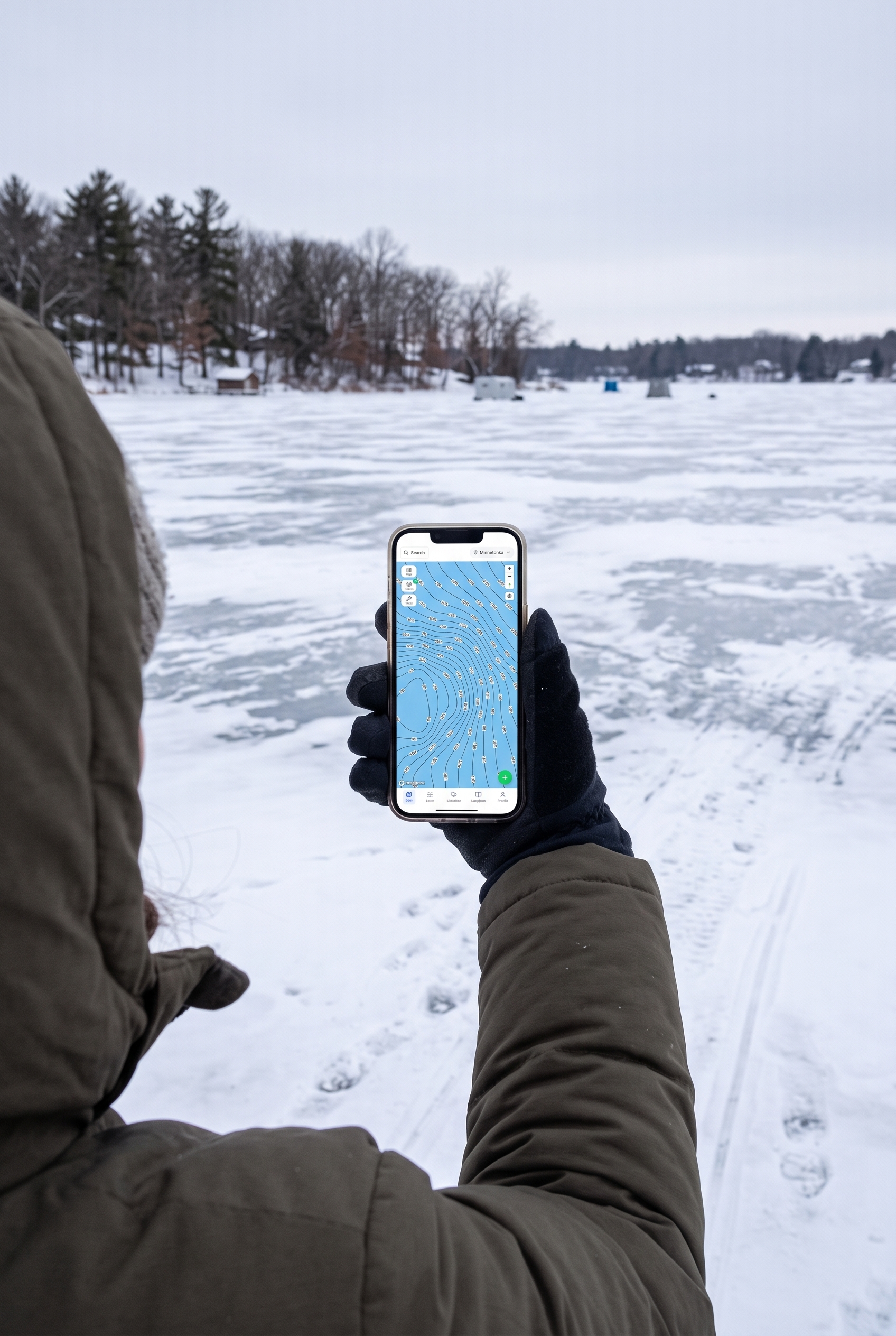
This is exactly what a 1-foot contour map is for. On a 5- or 10-foot map, an inside turn on a basin wall can disappear entirely. In Fish Guide Pro, set depth shading to color your target band (say 20 to 30 feet) and the basin edges jump off the screen. Then drop a waypoint on each inside turn so you can walk straight to it on the ice.
If you're new to reading the lines themselves, start with our guide to reading depth contour maps for fishing.
How to Drill for Suspended Crappie
Drill a line, not a cluster. Space holes along the basin's contour, starting shallow and ending with the last hole over the deepest water. That gives you a wide lane to intercept a school that's moving.
Drill them all first. Punch the whole line, then go back and check each hole with your flasher, shallow to deep. Drilling while fish are under you spooks them.
Look up, not down. Crappie feed upward. If your flasher shows fish at 18 feet, hold your jig 6 to 12 inches above them, around 17 feet. A bait below a crappie mostly gets ignored.
Be patient once you find them. On a cold, windy midwinter day, it often pays to set up a shelter on the best hole and wait for the school to swing back through, rather than chasing it. On a calm, mild day, stay mobile and hole-hop.
Live sonar speeds this up. Forward-facing sonar lets you see a roaming school from a distance, and many crappie anglers now use it. A flasher and a well-placed line of holes still catch plenty of basin crappie.
Fish the low light. Crappie bites often get better as the sun drops, and many Minnesota basins produce well after dark when fish rise in the water column.
Best Bait for Crappie Ice Fishing: Jigs, Plastics, and Minnows
Midwinter basin crappie are often barely opening their mouths. Smaller and slower usually beats bigger and louder.
| Situation | Jig | Tip it with | Line |
|---|---|---|---|
| First ice, active fish in weeds | 1/32 to 1/16 oz glow or chartreuse jig, or a small glow spoon | Crappie minnow or minnow head | 2 to 4 lb |
| Midwinter basin, neutral fish | 1/32 to 1/64 oz horizontal jig, or a 3 to 4 mm tungsten jig | One white spike, or a small finesse plastic | 2 lb high-vis mono; drop to 1 lb for finicky fish |
| Aggressive school, after dark | Small glow jig or flutter spoon | Crappie minnow, or a red and a white maggot | 2 to 3 lb |
How to work it: Use bigger, sharper jigging to call fish in from a distance, then go nearly still once they show on the flasher. Gentle shakes with 2 to 3 second pauses, or a slow lift and drop, outfish hard ripping. Some days the best cadence is no cadence: set the rod down and let the jig hang.
Color: Start with glow, white, or chartreuse. If fish come up and look but won't commit, try a dark purple or black jig.
Line tips: High-visibility line lets you see a light bite before you feel it. A spring bobber or sensitive tip rod shows bites you won't feel, because crappie often push the jig up instead of pulling down. A micro swivel about 18 inches above the jig stops line twist from spinning your bait.
For general jig sizing by depth, see our walleye jig weight chart. The same depth logic applies, just scaled down.
Minnesota Crappie Lakes Worth a Winter Trip
Each lake below is backed by a recent Minnesota DNR survey or the DNR's own 2026 area fishing outlook. Crappie populations swing with year classes and winterkill, so check the latest survey in the app before you go.
Clearwater Lake (Wright and Stearns counties)
Best for: numbers and size together, close to the metro.
Clearwater is a 3,158-acre lake two miles north of Annandale. The DNR's 2025 survey found crappie abundant with quality size structure. Special regulations apply here: a crappie daily limit of 5 and a sunfish daily limit of 10, including the connected Augusta, Caroline, Grass, and Otter lakes.
Look up Clearwater's basins and crappie survey in the app →
Diamond Lake and Willmar Lake (Kandiyohi County)
Best for: a two-lake day in west-central Minnesota.
The DNR's 2026 outlook for the Spicer area names Diamond and Willmar as two of the area's best combinations of crappie size and abundance. Diamond is the same 1,610-acre lake near Atwater that also made our best walleye lakes in Minnesota list, so you can split a day between crappie and walleye.
Compare Diamond and Willmar in the app →
Stella Lake (Meeker County)
Best for: a lake that already proved itself through the ice.
The DNR's 2025 spring trap netting found good numbers of crappie in Stella, and the DNR reports that ice anglers took advantage of it during the 2025–26 winter. Stella sits next to Lake Washington south of Darwin.
Look up Stella's survey in the app →
Parley Lake (Carver County)
Best for: a shot at a 15-inch slab in the west metro.
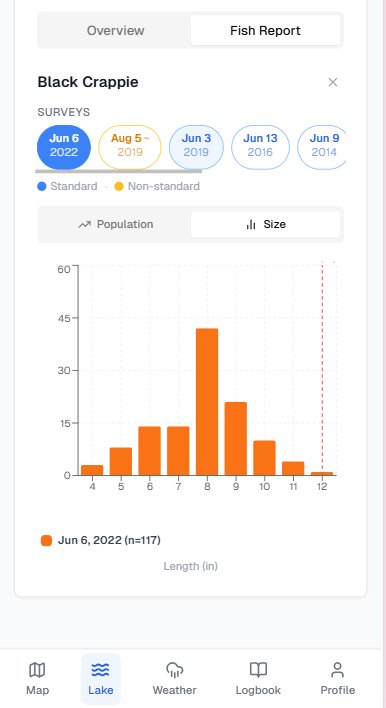
Parley is a 258-acre lake near St. Bonifacius with an 18-foot maximum depth. Be honest with yourself about this one: the 2025 DNR survey caught crappie in low numbers, averaging 7.9 inches. But the largest measured 15.3 inches, and the DNR called the presence of 15-inch-plus fish an encouraging sign. Parley is part of the DNR's Quality Sunfish Initiative, with a crappie daily limit of 5 and a sunfish daily limit of 5.
Parley tops out at 18 feet and winterkilled in 2022–23, so oxygen near the bottom can run low by late winter. Look for crappie over the deepest water but well off the bottom, and watch your flasher for fish suspended higher than you'd expect.
See Parley's crappie size chart in the app →
Upper Red Lake (Beltrami County)
Best for: bonus big crappie on a walleye trip.
Upper Red is famous for walleye, but the DNR's 2025 survey notes crappie showing up in angler catches more than they have in years. Nearly all are from the 2018 year class and average around 13 inches, with a few 14 and 15-inch fish from older classes. The DNR is clear that this is not a new crappie boom, so treat them as a bonus while you're up there for walleye. State-licensed anglers must stay on state waters on the east side of the lake.
Look up Upper Red's survey and regs in the app →
Crappie Limits and Ice Safety
The statewide crappie limit on Minnesota inland waters is 10 combined black and white crappie, and the season is open year-round. Many lakes, including Clearwater and Parley above, have a reduced daily limit of 5. Always check the lake's special regulations before you keep fish. In Fish Guide Pro, current special regs show on each lake's page.
Minnesota allows two lines per angler when ice fishing (one on designated stream trout lakes), so a second rod on a deadstick next to your jigging rod is legal and often productive.
The Minnesota DNR recommends at least 4 inches of new, clear ice for walking, and double that for white or snow-covered ice. Check thickness yourself as you go. See our Minnesota ice thickness chart for the full guideline table.
Crappie Ice Fishing FAQ
What depth do crappie go in winter in Minnesota? At first ice, usually 6 to 12 feet around green weeds. By midwinter, many move to soft-bottom basins, often 20 to 32 feet on deeper lakes, where they suspend off the bottom. On lakes with green cabbage beds, some stay shallow all winter.
What is the best bait for crappie ice fishing? A crappie minnow on a small glow jig is the most reliable start. For midwinter fish that won't commit, downsize to a 3 to 4 mm tungsten jig or a 1/32 to 1/64 oz horizontal jig with a single spike or a tiny plastic on 2 lb line.
Why do I mark crappie on my flasher but they won't bite? Usually the bait is too low, too big, or moving too much. Hold it 6 to 12 inches above the fish, downsize, and slow down to long pauses.
Do crappie bite at night through the ice? Yes. Many Minnesota basins fish best from sunset into the first hours of dark, when crappie rise in the water column to feed.
What is the crappie limit in Minnesota? The statewide limit is 10, but many lakes have a special limit of 5. Check each lake's regulations before keeping fish.
The hardest part of midwinter crappie is knowing where the basin wall bends before you're standing on it. Try Fish Guide Pro free and find the inside turn on your lake from the kitchen table.
Survey data from Minnesota DNR fish survey records and the DNR's 2026 area fishing outlooks via Fish Guide Pro. Regulations from the Minnesota DNR as of October 2026; confirm current regs before you keep fish.