"Bass fishing near me" is one of the most-searched fishing phrases in the state, and almost nothing written for it — or for "best bass lakes mn" — is actually Minnesota-specific. Most results are generic national content or somebody's "best bass lakes" list with no data behind it at all. This is the first bass content on Fish Guide Pro's blog, and we're opening that lane the same way we opened the walleye ones: real DNR numbers where they exist, an honest note about where they don't.
This page is the lake picks — where to go. If you want seasonal patterns, technique, and gear once you get there, see our full Minnesota Bass Fishing: Seasons, Technique & Gear guide.
Jump to a section:
🔎 A Quick Note on Bass Data
Most Minnesota DNR standard surveys are built around gill nets and trap nets, which are great for walleye, pike, panfish — and genuinely bad at sampling bass. A handful of the lakes we pulled data for while researching this post had largemouth listed as "present" with only one or two incidental fish caught, and the survey narrative said outright that the sample doesn't reflect the real population. That's not a knock on those lakes — it just means good bass water often doesn't show up clearly in the same DNR numbers that make our walleye content so solid. Where a lake has real electrofishing data (the method that actually targets bass), we show it. Where it doesn't, we say so instead of guessing.
One more data source worth knowing about: Minnesota requires a permit for organized bass tournaments, and permitted events have to report their catch data to the DNR. That's exactly how we have Minnetonka's tournament numbers below — real weigh-in data, not an estimate.
One regulation you need to know before you plan a trip: as of March 1, 2026, Minnesota moved to a continuous bass season on inland waters. There's no more closed season — outside the traditional harvest window (which opened May 23 in 2026; the exact date shifts slightly year to year with the usual bag limits), bass fishing is open catch-and-release, year-round. We checked every lake in this post against the DNR's special regulations database, and none carry a bass-specific slot or season override, so the continuous season applies as written on all of them — with one exception: Rainy Lake is a border water shared with Ontario, and border waters can carry separate regulations from inland lakes, so double-check before you fish it specifically.
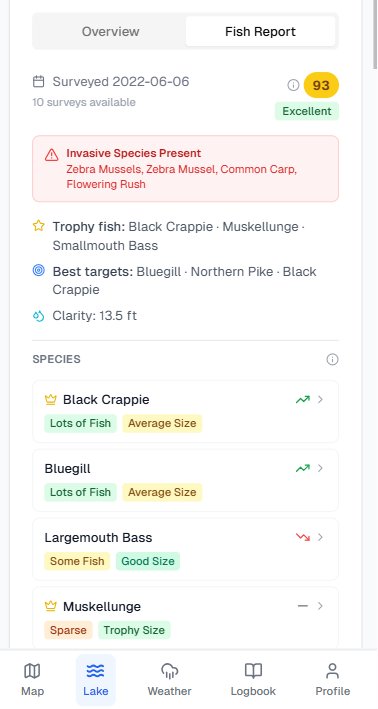
🏆 Featured Lake: Lake Minnetonka — Hennepin County
Best for: genuine trophy potential with real data behind it, 20 minutes from downtown Minneapolis
| Metric (2011 DNR Targeted Bass Electrofishing Survey) | Result |
|---|---|
| Catch rate | 75.4 bass/hour — above average for area lakes |
| Trophy score | 100.0 |
| Average size | 11.8" / 1.04 lb |
| Largest sampled | 20.9" / 4.9 lb |
| Year classes present | 1999–2009 — consistent long-term reproduction |
| 2022 tournament data | 792 anglers, 1,681 largemouth caught, avg 2.58 lb, largest 8.00 lb |
| Smallmouth (Lower Lakes basin only) | 4 fish sampled, 10.1"–18.3", avg 13.7" |
Minnetonka is the one lake on this list with real, dedicated bass electrofishing data instead of incidental catches, and the numbers back up its reputation — this is one of the most heavily tournament-fished lakes in the state for a reason. At 14,216 acres split across multiple bays, it's also big enough that you're never fighting the whole lake's fishing pressure for the same water. Eurasian watermilfoil is well established here, which is exactly the kind of vegetation that holds summer bass — target weed edges and dock structure in the connected bays rather than searching open water.
In tournament terms: a 2.58 lb average translates to roughly a 12–13 lb five-fish limit, which reads as a numbers-and-consistency lake rather than a one-big-bite lake — you're more likely to win here by finding a pattern that produces five solid keepers than by grinding for a single kicker. The 4.9 lb largest sampled fish (and 8 lb largest tournament fish) says the kicker is out there, but the bread-and-butter game on Minnetonka is limits, not lottery tickets.
Smallmouth are present too, though only in the Lower Lakes basin — the 2022 standard survey sampled four fish there, 10.1" to 18.3", averaging 13.7". If you want a shot at both species in one trip, that basin is where to look for smallmouth on rock, while largemouth spread across the whole lake's weed edges and docks.
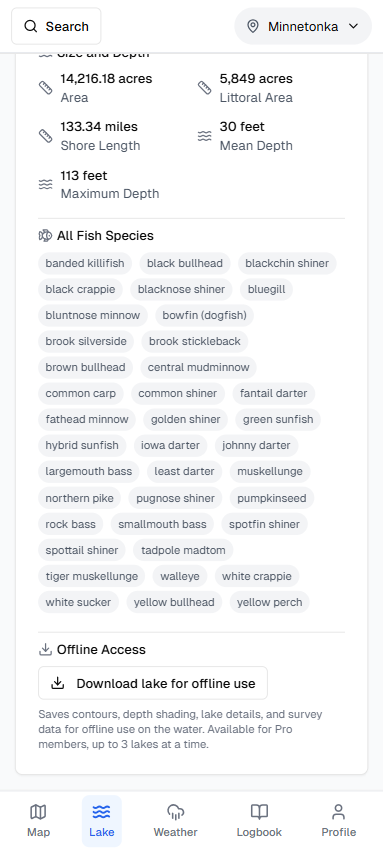
Bass are Minnetonka's headline, but they're one piece of a much bigger lake. For the full basin-by-basin breakdown — where pike, stocked trophy walleye, and muskie actually hold — see our Lake Minnetonka Fishing Guide.
🏆 Featured Lake: Christmas Lake — Hennepin County
Best for: exceptional clarity and a real (if slightly dated) electrofishing reference
| Metric | Result |
|---|---|
| Water clarity (2023) | 26.0 ft Secchi — exceptionally clear for a metro lake |
| 2018 electrofishing bass size range | 10.3"–18.6", described as abundant |
| 2023 incidental sample | 5 bass, 5.3"–14.4" (targeted electrofishing wasn't repeated) |
| Trophy score | 80.9 |
| Size | 267 acres, 87 ft max depth |
Christmas Lake is a small, deep, unusually clear metro lake — 26 ft of visibility is more what you'd expect from a northern Shield lake than something 20 minutes from Excelsior. The DNR's most recent standard survey didn't repeat targeted bass electrofishing, but it directly references the 2018 assessment, which found bass abundant and running 10.3–18.6 inches — genuine size structure, not just incidental catches. With that much clarity, downsize your line and lean on natural colors; bass in water this clear get a good look at anything that doesn't match the hatch.
🏆 Featured Lake: Whitefish Chain — Crow Wing County
Best for: the best documented bass fishery in this whole post outside Minnetonka
| Metric (2024 DNR Targeted Electrofishing Survey) | Result |
|---|---|
| Largemouth catch rate | 44.9 bass/hour |
| Average length | 13.1" |
| Size structure | 65% over 12", largest sampled 19.2" |
| Smallmouth bonus | 3 netted while electrofishing, all over 16" |
| Trophy score | 100.0 |
| Water clarity | 11.8 ft Secchi |
The Whitefish Chain near Crosslake got a real, dedicated largemouth electrofishing survey across the entire chain in 2024 — not just an incidental gill-net catch — and the results are excellent: a 44.9 bass/hour catch rate with real size behind it, two-thirds of sampled fish over 12", and fish up to 19.2". The three smallmouth netted as bonus catch, all over 16", suggest there's a real smallmouth component here too, even though the survey wasn't built to target them. At 14,620 connected acres, this is exactly the kind of diverse, multi-bay water that rewards a full day of exploring rather than parking on one spot — though with that many connected bodies of water, it's also easy to get turned around your first trip, so have a map loaded before you leave the dock.
In tournament terms: a 13.1" average with fish up to 19.2" is a real kicker-fish signal — this reads as a lake where one bite can change your day, not just a numbers lake. Worth committing time to fish through smaller fish looking for that upper-teens class rather than culling on the first limit you find.
📍 More Bass Water Close to the Metro
Lower Prior Lake, Scott County — a 957-acre lake with documented largemouth bass (average 11.1", largest 17.6" in incidental sampling) alongside walleye, pike, and panfish. Targeted bass electrofishing hasn't been done recently, so treat this as promising, developing data rather than a confirmed trophy fishery — worth checking yourself in Lake Info & Regulations before you make the drive.
Lake Waconia, Carver County — a 3,080-acre lake best known for walleye and muskie, but its 2025 incidental bass sample (27 fish, average 10.0", largest 19.3") shows real size potential mixed into a lake most anglers aren't fishing for bass specifically. No targeted electrofishing survey exists here either, so this is another "worth checking yourself" pick rather than a confirmed trophy lake.
Bde Maka Ska and Lake Nokomis, Minneapolis — if you're introducing a kid to bass fishing or just want a low-stakes evening out, these are genuinely good starter options: both hold documented largemouth populations, both are easy to reach on a weeknight, and Nokomis bans gas motors, making it a quiet, kayak- and canoe-friendly lake that's easy to fish from a small boat with a beginner aboard. Neither has been targeted-sampled recently enough to say much about size structure, so treat both as "good for learning and a fun evening," not a trophy destination. Worth knowing before you pick a city lake based on a "best of" list you find elsewhere: we checked Lake Harriet too, since it's often cited as a top Minneapolis bass lake online — its actual 2024 DNR survey lists largemouth among the least abundant species sampled, not the strongest. Always worth checking the real data instead of trusting a repeated claim.
Fishing without a boat? Find public fishing piers near you.
🚗 Beyond the Metro
Green Lake, Kandiyohi County — about two hours west of the Twin Cities, near Spicer. A 2024 DNR nearshore electrofishing survey confirmed both largemouth (CPUE 4.33) and smallmouth (CPUE 7.94) present, and the lake's Fish-based Index of Biological Integrity score (51) sits above the impairment threshold (45), with cisco documented — a coldwater species that only survives in genuinely clean, healthy lakes. This wasn't a size-structure survey, so we can't tell you exact length data the way we can for Minnetonka, but the underlying lake health and confirmed dual bass populations make it a legitimate pick if you're willing to make it a day trip. The DNR's own bass fishing page specifically calls out Green Lake's rocky, sandy shorelines as smallmouth water.
Rainy Lake, near International Falls — this is a genuine trophy smallmouth destination if you're willing to make it a special trip. Rainy is part of Minnesota's Large Lake Program (one of the state's 10 most intensively monitored lakes), and its 2025 DNR survey states plainly that smallmouth bass over 19 inches are commonly caught in both DNR sampling gear and by anglers, with trophy score maxed at 100.0. It's a walleye lake first and foremost, but the smallmouth fishery here is legitimately excellent, not an afterthought. Worth knowing before you launch: at 44,627 acres with real depth (nearly 149 ft max), Rainy can build wind and chop fast, and it's a border water with Ontario, so check both the marine forecast and border-water regulations before you go.
Gull Lake, near Nisswa — right in the heart of Brainerd Lakes resort country, and just up the road from the Whitefish Chain above. Bass showed up in the 2023 survey (largemouth and smallmouth both present), but that survey was gill-net based rather than electrofishing, so we don't have the same size-structure confidence here that we do for its neighbor. Worth checking if you're already in the area for the Whitefish Chain.
Leech Lake and Mille Lacs Lake — both already covered in our 10 Best Walleye Lakes post, and both are worth a mention here too. The DNR's own bass page specifically calls out Leech's many shallow, heavy-cover bays for largemouth (bring braided line, it gets thick), and Mille Lacs' rocky reefs and gravel bars for smallmouth. If you're already headed to either for walleye, don't leave the bass gear at home.
🚤 Launch & Ramp Notes
Worth knowing before a tournament-morning launch, pulled from the same DNR access records as everything else in this post:
| Lake | Access Notes |
|---|---|
| Lower Prior Lake | DNR access, up to 40 vehicle/trailer spaces |
| Lake Waconia | Three accesses — up to 40, 34, and 8 vehicle/trailer spaces respectively |
| Christmas Lake | Single city-owned ramp, capacity not published |
| Bde Maka Ska | City-owned, limited trailer parking |
| Lake Minnetonka | Multiple public and private launches across its bays — no single choke point |
❓ FAQ
What's the best bass lake near the Twin Cities? Of the lakes we pulled real data for, Lake Minnetonka has the strongest documented bass fishery — a 75.4 bass/hour electrofishing catch rate and consistent year classes going back over a decade, backed up by heavy tournament activity every season. Christmas Lake is the other standout, with a referenced 2018 electrofishing assessment showing abundant bass in the 10.3–18.6" range and exceptional water clarity.
What's the best bass lake if I'm willing to drive further? The Whitefish Chain near Crosslake has the best-documented bass fishery in this entire post outside Minnetonka — a dedicated 2024 electrofishing survey found a 44.9 bass/hour catch rate with real size structure behind it. If you want trophy smallmouth specifically, Rainy Lake near International Falls has the DNR's own word for it: fish over 19" are commonly sampled.
Why don't more Minnesota lakes have detailed bass data? Standard DNR surveys use gill nets and trap nets, which are effective for walleye, pike, and panfish but don't sample bass well. Real bass population data requires targeted spring electrofishing, which isn't run on every lake every year — so plenty of genuinely good bass lakes simply don't have the same depth of public data that a walleye lake might.
Is there a closed season for bass in Minnesota? No — as of March 1, 2026, Minnesota has a continuous bass season on inland waters. Outside the traditional harvest window that opens in May, bass fishing is legal catch-and-release, year-round, with no closed period. None of the lakes in this post carry a bass-specific override to that rule, though Rainy Lake is a border water with Ontario and may follow separate regulations, so double-check before you fish it.
Can I check bass data on a lake near me myself? Yes — search any lake in Lake Info & Regulations to see what species and survey data exist for it, the same way we did for the lakes in this post.
Every moment on the water is too good to waste fishing water that never had the numbers to back it up. Once you've picked a lake, see our Minnesota Bass Fishing: Seasons, Technique & Gear guide for what to throw and when. Try Fish Guide Pro free and check the DNR data on your bass lake before you launch.